



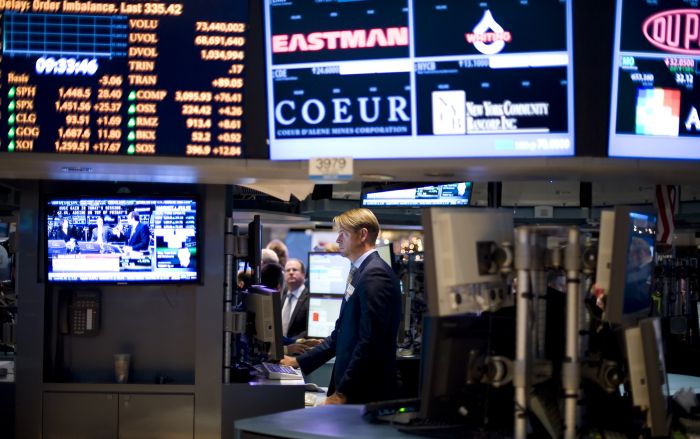
The Nasdaq Composite executed an impressive intraday reversal today, climbing 1.2% from session lows to sit near flat territory, as investors piled back into artificial intelligence infrastructure plays despite escalating U.S.-Iran tensions and a fresh spike in oil prices.
Nvidia shares advanced 2.86% to $202.56, reclaiming the psychologically important $200 level and providing crucial support for the tech-heavy index. The semiconductor giant’s resilience anchored a broader rally in AI-adjacent names, with memory and storage stocks leading the charge after what traders described as “a difficult few sessions.”
Western Digital surged 3.88% to $552.76, extending its six-month gain to 145.69% and its twelve-month advance to an extraordinary 715.68%. Sandisk climbed 3.84% to $1,679.90, having posted triple-digit percentage gains across every major time frame tracked by markets. The memory sector’s strength reflects renewed confidence in AI-driven storage demand, even as macro headwinds intensify.
Cloud infrastructure provider Nebius jumped 6.36% to $207.60, building on six-month gains exceeding 115% and a one-year surge of 329.09%. CoreWeave, another AI infrastructure play, added 5.12% to $87.81, though the stock remains down more than 50% from year-ago levels, illustrating the sector’s extreme volatility.
Top Australian Brokers
- Pepperstone - Top Australian broker - Read our review
- eToro - Invest in ASX and international shares - Read our review
Broadcom delivered a 4.50% gain to $387.45, propelled by news of a landmark supply agreement with Apple. Baker Hughes rounded out the top performers with a 4.20% advance to $56.76.
Apple-Broadcom Deal Reshapes Chip Supply Chain
The session’s most significant corporate development came from Apple, which formalized a commitment to spend over $30 billion with Broadcom on U.S.-manufactured wireless and radio-frequency chips over multiple years. The agreement, part of Apple’s broader $600 billion four-year U.S. investment initiative, represents the iPhone maker’s largest single commitment under its domestic chip manufacturing program.
The deal centers on FBAR (Film Bulk Acoustic Resonator) and related wireless components, with Broadcom expanding production capacity at its Fort Collins, Colorado facility. For Broadcom, the multi-year revenue visibility from a Tier-1 customer materially de-risks forward earnings and validates the company’s strategic focus on RF and networking franchises. The agreement effectively locks in a substantial portion of Broadcom’s premium RF pipeline through the end of the decade, making it significantly harder for competitors including Qualcomm to displace the company in critical Apple sockets.
Markets interpreted the announcement as validation of both U.S. chip onshoring policy and Broadcom’s positioning as a strategic supplier to the world’s most valuable technology company. The deal aligns with CHIPS Act objectives and provides concrete evidence that industrial policy initiatives are translating into tangible capital commitments.
Geopolitical Storm Clouds Gather
Wednesday’s tech rally unfolded against a darkening geopolitical backdrop. President Donald Trump declared that Washington’s ceasefire with Iran is “over” and threatened to reimpose a naval blockade in the Strait of Hormuz, following overnight clashes that included U.S. strikes on more than 80 Iranian targets and Iranian attacks on commercial vessels in the strategic waterway.
The escalation sent oil prices surging approximately 7% intraday and pushed the Dow Jones Industrial Average down several hundred points as markets priced in the risk of sustained supply disruptions. The Strait of Hormuz, through which roughly one-fifth of global oil flows, has become a flashpoint as tensions ratchet higher.
Yet the Nasdaq’s ability to reverse course and finish near unchanged—led by AI infrastructure names—demonstrates a striking divergence between traditional cyclical sectors and secular growth technology. Markets appear willing to look through near-term geopolitical noise when it comes to AI compute demand, treating mega-cap tech and AI infrastructure as relative safe havens during periods of macro uncertainty.
Not all technology stocks participated in the afternoon recovery. Consumer internet and software platforms bore the brunt of selling pressure, with Airbnb down 4.28% to $142.43, Palantir falling 4.32% to $128.57, and Palo Alto Networks declining 4.45% to $322.04. Shopify dropped 4.48% to $116.43, while DoorDash slid 4.95% to $186.03.
Private Space Valuation Milestone
In another significant development, Jeff Bezos’ Blue Origin raised approximately $10 billion in its first external funding round at a pre-money valuation of $130 billion. The round, reportedly led by institutional investors including Coatue alongside Bezos himself, places the space company among the most highly valued private technology and industrial enterprises globally.
The valuation milestone signals investor conviction that commercial launch, in-space infrastructure, and satellite internet represent multi-hundred-billion-dollar opportunities. For public small-cap space companies, the private-market benchmark may support higher multiples across the sector. However, the eye-watering valuation also raises questions about speculative excess in frontier technology themes, particularly when juxtaposed with rising macro risks.
The ability to raise $10 billion for a capital-intensive, long-duration project underscores the continued depth of risk capital available for flagship frontier-tech ventures, even in an environment of elevated interest rates and geopolitical uncertainty.
Bull Case:
- AI infrastructure demand remains insulated from short-term geopolitical and macro shocks
- Apple-Broadcom deal validates multi-year chip onshoring theme with concrete capital commitments
- Nasdaq’s intraday reversal demonstrates strong dip-buying appetite in secular growth technology
- Memory sector rally reflects sustained data center build-out and AI storage requirements
- Nvidia above $200 provides technical and psychological support for broader AI ecosystem
Bear Case:
- Iran escalation and Strait of Hormuz blockade risk threaten sustained oil supply disruption
- Memory stocks’ triple-digit gains embed elevated expectations vulnerable to disappointment or correction
- Consumer platform weakness signals rotation away from high-multiple software and discretionary spending
- Blue Origin’s $130 billion valuation may indicate speculative excess in frontier technology themes
- Geopolitical uncertainty and higher energy costs could compress growth-stock multiples across technology
The session’s price action encapsulates the central tension facing technology markets: powerful secular tailwinds from AI infrastructure investment colliding with mounting cyclical and geopolitical headwinds. Rising oil prices, potential supply disruptions, and military escalation in the Middle East typically pressure risk assets and compress growth-stock multiples, yet the Nasdaq demonstrated remarkable resilience.




