



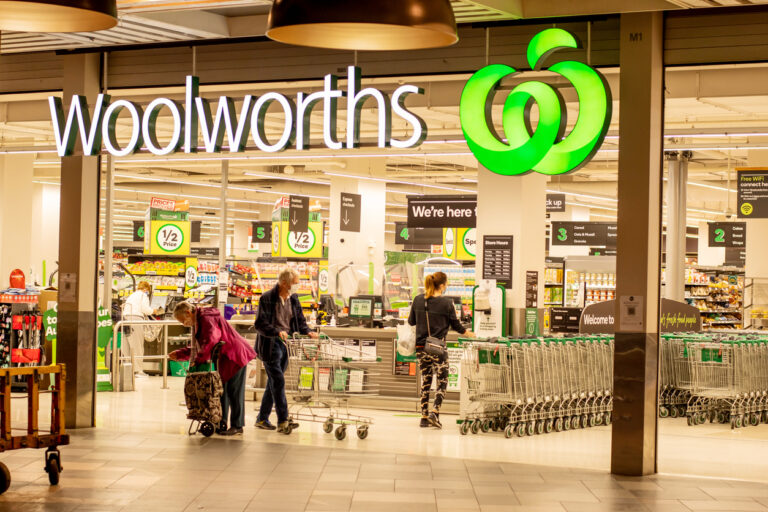
Woolworths shares (ASX:WOW) have emerged as a new favourite among Wall Street analysts, with Goldman Sachs initiating coverage with a Buy rating and setting a price target that implies approximately 20% upside potential, marking a notable shift in sentiment toward Australia’s largest supermarket operator.
The Woolworths share price has added 3.5% since the beginning of 2026, building on a wave of increasingly bullish analyst commentary that suggests the company’s operational challenges may finally be turning a corner. Trading at the A$30.46 mark, shares remain well below Goldman Sachs analyst Peter Marks’ A$37 price target, leaving substantial room for appreciation if the firm’s thesis proves correct.
Goldman Sachs’ initiation represents the latest in a series of upgrades that have repositioned Woolworths in the eyes of institutional investors. Marks specifically highlighted the Australian Supermarket segment as reaching a “turning point,” with measurable improvements in product and shelf availability addressing longstanding operational headwinds that have weighed on the stock’s performance over the past year.
The positive momentum began building in November 2025 when JPMorgan upgraded Woolworths from Neutral to Overweight, raising its price target to A$31.00. That call was predicated on improved sales momentum under new commercial leadership and a narrowing sales growth gap compared to arch-rival Coles Group. JPMorgan analysts pointed to strategic shifts toward impulse categories and enhanced promotional activities as key drivers of the sales recovery, suggesting management’s tactical adjustments were beginning to resonate with consumers.
Top Australian Brokers
- Pepperstone - Top Australian broker - Read our review
- eToro - Invest in ASX and international shares - Read our review
Bell Potter Securities followed suit in mid-December 2025, upgrading Woolworths from Hold to Buy with a one-year price target of A$31.05. The upgrade reflected improved valuation metrics and performance indicators that suggested the company was successfully executing its turnaround strategy. The convergence of bullish calls from multiple independent research houses has provided validation for the operational improvements management has been implementing.
Technical indicators have also turned bullish for Woolworths. As of mid-January 2026, the Moving Average Convergence Divergence stood at a positive 0.21, while the 20-day exponential moving average of A$29.31 sat comfortably below the current share price. These metrics suggest underlying momentum remains constructive, with the stock breaking above key resistance levels that had capped gains in previous months.
Not all analyst commentary has been uniformly positive, however. Macquarie maintained a Neutral rating in October 2025 while lowering its price target to A$29.60, citing concerns over margin recovery and competitive pricing pressures. The firm cautioned that potential market share losses and an intensifying promotional environment could constrain long-term growth prospects, even as near-term sales trends showed improvement.
The split in analyst opinion reflects the complex operating environment facing Australian supermarket operators. While product availability and sales momentum have clearly improved, questions remain about the sustainability of margin expansion in a fiercely competitive market where consumers remain price-sensitive following years of elevated inflation. The Australian Competition and Consumer Commission has also maintained scrutiny of the sector, adding a layer of regulatory uncertainty that could impact pricing strategies.
Woolworths’ performance in its Australian Supermarket division will be critical to validating the bullish thesis. The segment generates the lion’s share of group earnings and has historically been the primary driver of shareholder returns. Improvements in stock availability and ranging decisions suggest supply chain issues that plagued the business in prior periods have been largely resolved, allowing the company to better compete on product selection and in-store execution.
The company’s digital and loyalty initiatives have also shown promise, with online sales continuing to grow as a percentage of total revenue. Woolworths’ established e-commerce infrastructure provides a competitive advantage in capturing consumer spending as shopping habits continue to evolve, though the higher cost-to-serve in online channels remains a margin headwind that management must navigate carefully.
Bull Case:
- Product availability improvements strengthen competitive position against Coles
- New commercial leadership driving sales momentum and narrowing market share gap
- Multiple analyst upgrades suggest operational turnaround gaining traction and credibility
Bear Case:
- Intense promotional environment and pricing pressure threaten margin recovery expectations
- Macquarie cautions potential market share losses could constrain long-term growth
- Regulatory scrutiny from ACCC adds uncertainty to future pricing strategies
Woolworths faces a delicate balancing act between driving sales growth through competitive pricing and promotional activity while simultaneously protecting the margin recovery that markets are anticipating, with the next quarterly trading update likely to provide crucial evidence of whether management can successfully navigate this challenge and justify the increasingly bullish Wall Street sentiment.




