



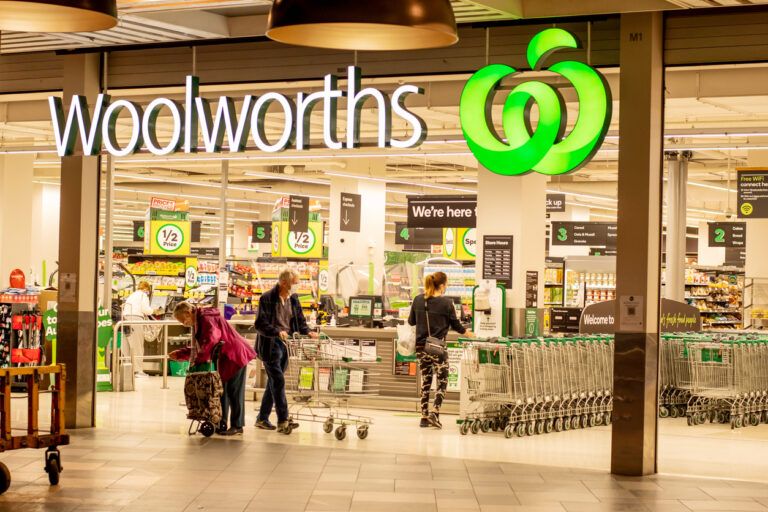
Woolworths shares (ASX:WOW) surged to their highest level in eighteen months after the Australian supermarket giant delivered better-than-expected earnings and announced a substantial dividend increase, signalling resilience despite ongoing consumer pressures.
The Woolworths Group share price closed 12.97% higher at A$35.63, representing both the session high and the stock’s strongest level since August 2024. The rally added more than A$4billion to the company’s market capitalisation in a single session, with the stock trading on elevated volume as markets responded enthusiastically to the half-year results. Up 21% YTD, the share price performance significantly outpaces the broader ASX 200 index, reflecting strong investor appetite for the defensive retail sector amid mixed economic signals.
Financials
For the six months ending January 4, 2026, Woolworths reported group sales of A$37.14 billion, representing a 3.4% increase on the prior corresponding period. More impressively, underlying net profit after tax surged 16.4% to A$859 million, demonstrating the company’s ability to expand margins despite challenging trading conditions.
However, the headline statutory net profit after tax painted a more complicated picture, falling 49.4% to A$485 million. This sharp decline stemmed primarily from a Federal Court judgment related to the underpayment of salaried managers, which resulted in a substantial one-off payout. Excluding this exceptional item, the underlying business performance remained robust across most divisions.
Top Australian Brokers
- Pepperstone - Top Australian broker - Read our review
- eToro - Invest in ASX and international shares - Read our review
The company’s Australian Food division, which accounts for the lion’s share of group earnings, delivered particularly strong results. Sales growth accelerated through the period, with management highlighting improved operational efficiency and effective cost management as key drivers of margin expansion.
Dividend Strengthens Appeal
Woolworths declared an interim dividend of 45 cents per share, fully franked, representing a 15.4% increase over the 39 cents per share interim dividend paid in April 2025. The dividend matches the final dividend distributed in September, bringing total dividends for the full year to 90 cents per share on an annualised basis.
The dividend will trade ex-entitlement on March 4, 2026, with a record date of March 5 and payment scheduled for April 2. Shareholders have until the close of trade on March 3 to acquire shares and receive entitlement to the distribution. The company is also running its dividend reinvestment plan for this payment, with shareholders able to elect participation until 5pm on March 6.
Based on the current share price, Woolworths now trades on a forward dividend yield of 2.57%, up from a trailing yield of 2.4%. The fully franked nature of the distribution enhances the effective yield for Australian taxpayers, particularly those in higher tax brackets.
Trading Outlook
CEO Amanda Bardwell provided measured commentary on the current trading environment, noting both strengths and ongoing challenges. “Trading in Q3 to date has been strong in Australian Food; however, customers continue to be value-focused, shopping multiple retailers in a highly competitive environment,” Bardwell stated in the earnings release.
This observation highlights the dual reality facing Australian supermarkets: while aggregate sales volumes remain healthy, intense competition from rivals including Coles, Aldi, and emerging online players continues to pressure pricing power. Customers are increasingly price-sensitive, comparison shopping across multiple channels and retailers to maximise value.
The competitive dynamics have intensified regulatory scrutiny as well, with the Australian Competition and Consumer Commission maintaining close oversight of pricing practices across the sector. This regulatory backdrop adds another layer of complexity to strategic decision-making around pricing and promotional activity.
The strong performance comes against a backdrop of moderating but still-elevated inflation in Australia, with food prices remaining a particular concern for households. While inflation has retreated from peak levels, grocery bills remain significantly higher than pre-pandemic norms, driving the value-focused behaviour Bardwell described.
The supermarket sector has faced reputational challenges over the past year, with parliamentary inquiries examining pricing practices and profit margins. Both Woolworths and rival Coles have faced accusations of price gouging, though both companies have defended their pricing as competitive and appropriate given cost pressures.
Despite these headwinds, the defensive characteristics of supermarket earnings continue to attract investor interest, particularly as economic uncertainty persists. Essential spending on food and household goods tends to remain relatively stable through economic cycles, providing predictable cash flows that support consistent dividend payments.
Outlook and Market Positioning
Looking ahead, Woolworths faces a delicate balancing act between maintaining competitive pricing to protect market share while defending margins in the face of persistent cost pressures. Wage inflation, energy costs, and supply chain expenses continue to challenge the sector, even as some commodity prices moderate.
The company’s digital and e-commerce capabilities represent a potential growth driver, with online grocery penetration still relatively low in Australia compared to more mature markets. Investments in automation, logistics, and digital customer engagement could provide competitive advantages and margin benefits over time.
The competitive environment shows no signs of easing, with Aldi continuing its steady expansion across Australia and Coles matching promotional activity dollar-for-dollar. This intensity limits pricing power but also creates opportunities for well-executed retailers to gain share through superior customer experience and value proposition.
Bull Case:
- Underlying profit growth of 16.4% demonstrates strong operational leverage and margin expansion capability
- Dividend increase of 15.4% signals management confidence in sustainable earnings growth trajectory
- Market share gains in Australian Food division show competitive positioning strength despite intense rivalry
- Resolution of legal settlement removes overhang and allows management focus on core operations
- Defensive earnings profile provides stability amid broader economic uncertainty and market volatility
Bear Case:
- Statutory profit decline of 49.4% highlights exposure to legal and regulatory risks
- Intensely competitive environment limits pricing power as customers shop multiple retailers for value
- Valuation multiples have expanded significantly following rally, reducing margin of safety for investors
- Ongoing regulatory scrutiny of pricing practices creates reputational and operational risks
- Consumer value-focus and multi-retailer shopping behaviour threatens customer loyalty and wallet share
While today’s strong earnings beat and generous dividend increase have clearly resonated with markets, the path forward remains dependent on Woolworths’ ability to navigate an intensely competitive landscape where value-conscious consumers show little brand loyalty. The company’s operational improvements and margin expansion provide encouragement, but sustaining this momentum will require continued execution excellence as regulatory scrutiny intensifies and economic uncertainty persists.




