



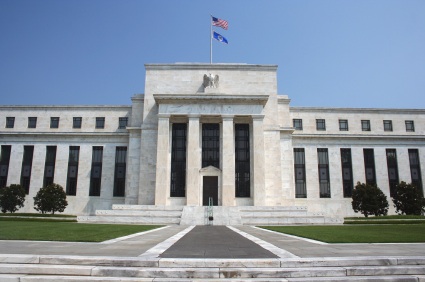
Kevin Warsh’s first Federal Reserve meeting as Chair delivered a disciplined, hawkish surprise that rattled markets expecting an easier path, as the central bank held rates steady while stripping forward guidance and signalling potential further tightening ahead.
U.S indices, including the Nasdaq 100 (-0.99%), S&P 500 (-1.21%), Dow Jones (-0.98%), and the Nasdaq Composite (-1.34%) sold off sharply following the FOMC announcement, with yields climbing across the curve as the dovish Warsh narrative evaporated.
The unanimous decision to maintain the Federal Funds target range at 3.50-3.75% came alongside a drastically shortened policy statement that removed all easing bias, catching markets off guard. Treasury yields rose immediately as traders repriced rate expectations, while Asian markets braced for spillover effects from the shift toward a more restrictive stance. The dollar initially strengthened on the hawkish tone, though analysts expect this move to moderate as energy geopolitics stabilize.
Asian markets were mixed on the day, with the SSE Composite down 0.43%, the Hang Seng falling back 1.59%, whilst the Nikkei 225 added 1.65%, and the KOSPI led on the day, up 2.25%.
Structural Overhaul
The most striking aspect of Warsh’s debut was not the hold itself, but rather a fundamental restructuring of Fed communication.
Top Australian Brokers
- Pepperstone - Top Australian broker - Read our review
- eToro - Invest in ASX and international shares - Read our review
The post-meeting statement was cut roughly in half compared to the April template, stripping out the traditional four-paragraph format that detailed reaction functions and explicit forward guidance. Gone entirely was the easing bias language referencing “the extent and timing of additional adjustment” that had characterized recent statements under the previous regime.
This deliberate break from Powell-era communication represents a shift toward shorter, more descriptive statements that place greater weight on actual data rather than calendar-based guidance. Markets interpreted the move as widening the distribution of potential outcomes, supporting higher implied volatility across rates and equities while tightening financial conditions through elevated risk premia.
What Was Said
The truncated statement offered succinct assessments across key macro indicators. Growth was characterized as “solid,” with explicit recognition that productivity growth and capital investment remain strong, a clear nod to Warsh’s optimistic view on artificial intelligence’s potential to drive efficiency gains. The labor market description improved to reflect better balance, noting that job gains have kept pace with workforce growth rather than overheating.
On inflation, the Fed attributed above-target price pressures primarily to energy supply shocks, while Warsh emphasized the central bank’s unwavering commitment to its 2% target. In the press conference, the Chair explicitly ruled out any adjustment to that long-held objective, disappointing those who had speculated about a more accommodative framework.
The Summary of Economic Projections revealed a notably gradual normalization path. The median forecast indicates one rate hike this year, followed by just one cut in 2027 and another in 2028. Significantly, Warsh declined to submit his own forecasts, reinforcing the de-emphasis of dot-plot theatrics. Yet the committee remains divided, with nine of eighteen participants expecting at least one hike this year, a material hawkish skew that keeps tightening firmly on the table.
Institutional Perspective
 Tai Hui, APAC Chief Market Strategist at J.P. Morgan Asset Management, offered measured analysis of the meeting’s implications.
The firm maintains its baseline view that the Fed will make no rate adjustments through year-end, interpreting the committee’s posture as comfortable patience given current policy positioning. This stands in contrast to the SEP’s median projection, suggesting J.P. Morgan sees the hawkish dots as precautionary rather than predictive.
For Asian markets specifically, J.P. Morgan expects initial risk-off spillover as the region mirrors U.S. reactions to higher-for-longer rate risks. However, the firm identifies a potential medium-term tailwind: with a U.S.-Iran deal reportedly on the horizon that could ease energy supply constraints, markets may come to interpret the Fed’s hawkishness as precautionary positioning against transitory shocks rather than a sustained tightening campaign.
Such a development would likely reverse recent dollar strength and prove more supportive of Asian equities as funding conditions stabilize.
What To Watch
The new regime creates clear winners and losers across asset classes.
Long-duration bonds face headwinds from higher real rates and reduced forward guidance, while rate-sensitive growth equities such as unprofitable tech names confront elevated discount rates and policy uncertainty. We have seen this early with ASX tech shares down on the day.
For credit markets, the solid growth backdrop supports spreads in the near term, though over-levered borrowers face pressure if yields grind higher. Yields rising, along with the US Dollar, has led to an early move in gold prices today.
The interplay between Fed policy, energy geopolitics, and dollar dynamics will prove crucial for Asian risk assets in coming months. A scenario where oil prices moderate while the Fed’s hawkishness is revealed as precautionary rather than structural would support a rotation back into emerging Asia, benefiting from cheaper funding and sustained global demand for technology hardware and infrastructure.
Either way, news of a signed provisional deal by both the US and Iran this morning has seen US futures look to bounce back ahead of the open. The QQQ ETF has the Nasdaq 100 priced for a 1.35% bounce so far, the SPY +0.46%, and the IWM +0.98%. Intel’s shares are also jumping, up 8.2% following comments from President Trump that a chip deal has been signed with Apple.




