



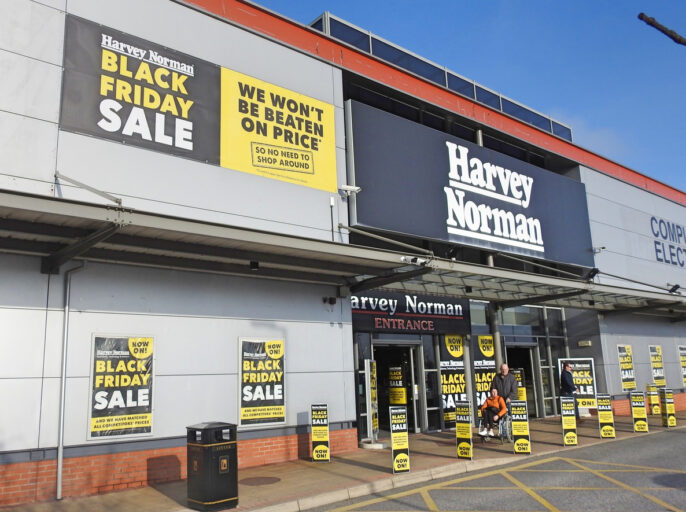
Harvey Norman shares (ASX: HVN) tumbled to the bottom of the ASX 200 ahead of the weekend, despite a strong HY report. The move lower is a result of falling short of consensus forecasts, demonstrating once again that in the stock market, meeting elevated expectations matters more than absolute performance.
The Harvey Norman share price closed 9.01% lower at A$5.76, marking the stock’s worst single-day performance in recent months and extending its year-to-date decline to 17.83%. The shares closed at its intraday low, with no late-session recovery materialising despite what appeared on the surface to be a solid set of financial results. The sharp selloff positioned HVN as the worst performer across the benchmark ASX 200 index for the session, wiping hundreds of millions from the retailer’s market capitalisation.
The Financials Behind The Move
For the half-year ending December 31, 2025, Harvey Norman reported total system sales revenue up 6.9% to $5.16 billion, while profit before tax increased 16.5% to $466.31 million. Net profit after tax and non-controlling interests rose 15.2% to $321.91 million, with earnings before interest and tax climbing 14.4% to $527.53 million.
Basic earnings per share improved 15.3% to 25.84 cents, and the company rewarded shareholders with a fully-franked interim dividend of 14.5 cents per share, representing a 20.8% increase on the prior corresponding period. On the surface, these figures paint a picture of a business firing on multiple cylinders.
Top Australian Brokers
- Pepperstone - Top Australian broker - Read our review
- eToro - Invest in ASX and international shares - Read our review
The franchising operations, which form the core of Harvey Norman’s Australian business model, posted a 14.2% increase in profit before tax, driven by improved margins and robust sales across the network. This segment remains the engine room of profitability, with franchise fees and support services contributing significantly to group earnings.
Overseas company-operated stores delivered notable profit improvements, particularly in Singapore, Malaysia, New Zealand, Ireland, Slovenia, and Croatia. However, these gains were partially offset by expansion costs in the United Kingdom, where the company continues to invest in building market presence despite near-term margin pressure.
The property division, often overlooked by markets focused purely on retail metrics, contributed profit before tax of $178.82 million, up 7.8% on the prior period. Rental growth and low vacancy rates underpinned the result, with additional support from a fair value uplift in the New Zealand property portfolio. This division’s contribution highlights the diversified earnings base that executive chairman Gerry Harvey frequently emphasises when differentiating his company from pure-play retailers.
The balance sheet remains in robust health, with net assets standing at $4.95 billion and a conservative net debt to equity ratio of just 13.02%. Operating cash flows reached $392.88 million, supported by solid cash receipts from both retail sales and franchise fees, delivering a cash conversion ratio of 96.2%.
The Expectations Gap
Despite these objectively strong numbers, analyst commentary suggests the results fell marginally short of consensus forecasts. Citi analyst Adrian Lemme noted that underlying profit of $373 million came in below the consensus expectation of $380 million, according to reporting by ShareCafe. This $7 million shortfall, while modest in absolute terms, proved sufficient to trigger a reassessment of valuation multiples.
Adding to market concerns, January trading figures revealed that Australian franchise like-for-like sales increased by 3.6%, falling short of the anticipated 5.7% growth rate. This deceleration in same-store sales momentum raised questions about whether the strong half-year performance can be sustained through the second half, particularly as cost-of-living pressures continue to weigh on discretionary consumer spending.
Analysis
The sharp selloff reflects a broader challenge facing Australian retailers: markets have become increasingly unforgiving of even minor disappointments, particularly for stocks that have enjoyed strong runs. Harvey Norman’s share price had performed well through 2025, setting up expectations that proved difficult to exceed.
The deceleration in January like-for-like sales growth also warrants monitoring. While a 3.6% increase still represents positive momentum, the gap between actual and expected performance suggests either that analyst forecasts were too optimistic or that underlying consumer demand is softening more rapidly than anticipated. With interest rates remaining elevated and household budgets under pressure, discretionary spending on furniture, electronics, and homewares faces ongoing headwinds.
On the positive side, the company’s diversified earnings base provides some insulation from pure retail volatility. The property division’s steady performance and the overseas operations’ growth trajectory offer alternative profit drivers if Australian retail conditions deteriorate. The strong balance sheet and healthy cash generation also provide flexibility to weather challenging periods while maintaining dividend payments.
The 20.8% increase in the interim dividend signals management confidence in the sustainability of earnings, though markets will scrutinise second-half trading updates for confirmation that momentum can be maintained. With a fully-franked yield now exceeding 5% on an annualised basis at current prices, income-focused investors may see value emerging after the selloff.
In short, Harvey Norman’s 9% share price decline underscores a fundamental market truth: strong absolute performance means little if it fails to exceed consensus expectations. While the company delivered double-digit profit growth, improved margins, and a substantial dividend increase, the modest miss on underlying profit and softer January sales momentum proved enough to trigger a re-rating ahead of the weekend.
Bull Case:
- Double-digit profit growth across franchising and overseas operations demonstrates business strength
- Property portfolio provides diversified earnings and $178.82 million in stable income
- Strong balance sheet with 13.02% net debt to equity supports dividends
- 20.8% dividend increase signals management confidence in earnings sustainability
- 96.2% cash conversion ratio demonstrates high-quality earnings generation
Bear Case:
- Results missed consensus expectations with underlying profit $7 million below forecasts
- January like-for-like sales of 3.6% significantly below expected 5.7%
- 17.83% year-to-date decline suggests sustained negative market sentiment persists
- Cost-of-living pressures threaten discretionary spending on furniture and electronics
- UK expansion costs offsetting overseas gains may continue weighing margins




