



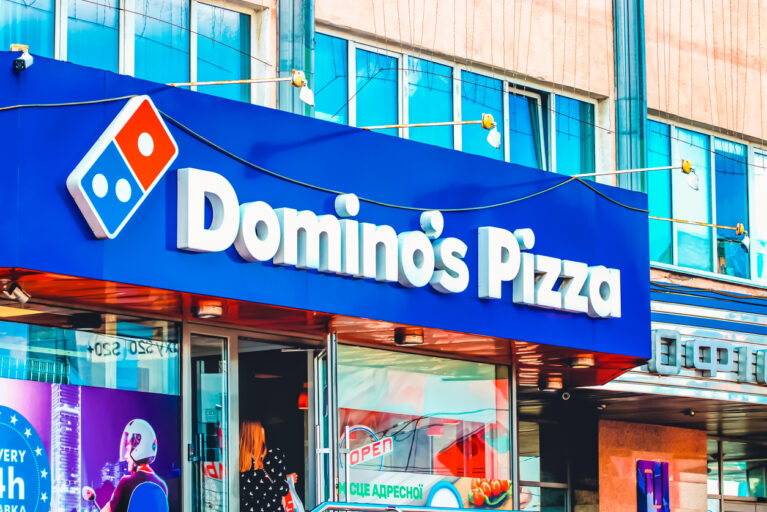
Domino’s Pizza shares (ASX: DMP) jumped 9.08% to A$19.59 today after the company delivered preliminary FY26 results that met guidance and showcased a dramatic improvement in cash generation, even as the pizza chain operator confirmed substantial write-downs and a deliberate shift away from aggressive store expansion.
The Domino’s share price bounced as the company reported preliminary unaudited underlying net profit after tax of A$118 million to A$122 million for the fiscal year ending in May, landing squarely within prior guidance. More significantly, free cash flow surged to approximately A$164 million, up A$116.6 million year-on-year, signalling that management’s operational reset is beginning to translate into tangible financial results.
DMP Shares Having A Volatile Year
Despite the positive reaction, Domino’s shares remain down 10.22% year-to-date, reflecting the challenging journey the company has navigated over the past 12 months. The stock had been under pressure as markets questioned the sustainability of the group’s international expansion model amid rising costs, competitive intensity, and uneven performance across key geographies.
The FY26 update revealed a company in transition.
Top Australian Brokers
- Pepperstone - Top Australian broker - Read our review
- eToro - Invest in ASX and international shares - Read our review
Same-store sales declined 4.1% for the full year, a headline number that would typically alarm markets. However, management framed the contraction as a deliberate strategic choice, prioritising sustainable unit economics over chasing low-margin volume. That narrative gained credibility from another key metric: franchisee profitability rose 11.3% over the 12 months to Q3 FY26 on a constant-currency basis, demonstrating that the financial health of individual stores is improving even as transaction volumes soften.
The company’s comprehensive asset review resulted in expected write-downs totalling approximately A$259 million, with roughly A$246 million classified as non-cash impairments. The charges relate primarily to underperforming operations in France and Taiwan, alongside IT development costs and certain store assets. While substantial, the non-cash nature of most write-downs means the impact on near-term cash generation is limited.
Net leverage improved to approximately 1.9 times EBITDA, down from higher levels in recent years, providing the company with increased financial flexibility. The deleveraging reflects both the stronger cash flow generation and management’s more conservative approach to capital deployment.
Analyst Bullish Following Print
UBS analyst commentary following the results helped frame market sentiment. The investment bank retained its Buy rating on Domino’s, explicitly describing the store closures and network contraction as a deliberate pivot toward profitability rather than a signal of structural decline. However, UBS did trim its price target from A$24 to A$22, acknowledging the reset in growth expectations.
The broker’s updated forecasts reveal the magnitude of the strategic shift. Store network revisions for the second half of FY26 include net closures of 25 stores in Europe, mostly in France, 13 stores across Asia, and two in Australia and New Zealand. Looking forward, UBS now models net store growth of just 0.5% in FY27, 1.0% in FY28, and 2.0% in FY29, assuming the closure program concludes by the end of FY26. These figures represent a dramatic departure from the high-single-digit or double-digit expansion rates that once characterised Domino’s growth story.
UBS trimmed its FY26 earnings per share estimate by 0.8% and FY27 by 0.5%, with lower store numbers partially offset by expectations for higher margins as weak units exit the network. Notably, the broker’s FY26 underlying NPAT forecast of A$122.5 million sits above the consensus estimate of A$118.8 million, suggesting some analysts may still be positioned conservatively.
What Lay Ahead?
The tension between improving unit economics and declining system-wide sales growth sits at the heart of the investment debate. Markets must weigh whether the franchisee profitability gains represent a durable structural improvement or simply reflect temporary cost relief and less aggressive discounting. If same-store sales weakness persists, the question becomes whether Domino’s is ceding market share to competitors or facing broader category headwinds in quick-service restaurants.
The write-downs in France and Taiwan also warrant scrutiny. While management is drawing a line under past capital allocation mistakes, the scale of impairments raises questions about the viability of certain international markets and whether further restructuring may be required. France, in particular, has proven challenging for multiple international restaurant brands, with intense local competition and consumer price sensitivity creating difficult operating conditions.
The improved free cash flow and reduced leverage do provide management with options. With approximately A$164 million in annual free cash flow and net leverage at 1.9 times EBITDA, the company could potentially resume or increase dividend payments, fund selective buybacks, or invest in technology and format innovation. However, with net store growth projected to remain anaemic through FY29, markets may increasingly view Domino’s as a cash-return story rather than a compounding growth franchise, which could limit multiple expansion even if fundamentals stabilise.
With the Domino’s share price having now added 25% since the start of FY27, bulls will be looking for a much stronger year from a stock which remains 83% lower over the past five years.
Bull Case:
- Free cash flow inflection to A$164 million demonstrates operational reset is working
- Franchisee profitability up 11.3% ensures system health and long-term sustainability
- Net leverage at 1.9x EBITDA provides financial flexibility for returns
- Non-cash write-downs clear legacy issues without impairing cash generation capacity
- UBS above-consensus forecast suggests guidance may prove conservative at top end
Bear Case:
- Same-store sales down 4.1% raises questions about brand momentum and competitiveness
- Net store growth of only 0.5-2.0% through FY29 ends high-growth narrative
- A$259 million write-downs signal significant past capital allocation failures in France Taiwan
- Structural challenges in problem markets may require further restructuring beyond FY26
- Reliance on cost discipline rather than revenue growth limits upside potential




