



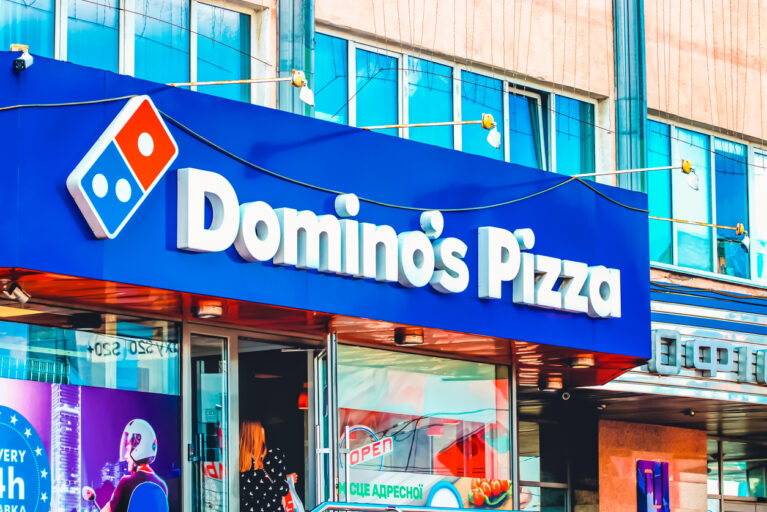
Domino’s Pizza Enterprises (ASX:DMP) delivered a cautiously encouraging trading update at its Annual General Meeting today, revealing that the pace of same-store sales declines is meaningfully slowing across its global network. For a stock that has been one of the ASX’s most volatile large-cap names in recent years, the muted market reaction may itself be the most telling signal of the day.
The DMP share price edged just 0.31% lower to A$22.19 following the AGM update, a move that left the technical uptrend firmly intact. The stock tested its 30-day simple moving average of A$21.54 intraday before recovering, and remains comfortably above both its 50-day SMA at A$20.71 and its 200-day SMA at A$18.69. That the share price absorbed a still-negative same-store sales print without breaking structure will be welcome for holders who have had to endure plenty of volatility in recent years.
This year in particular has been a tale of two halves for DMP, with a 28% sell-off into through the first half of calendar 2026 followed up by a 41.97% rally, leaving the stock up 1.7% year-to-date. The recovery in the second half looks strong in percentage terms, yet when you zoom out to the 5 year, the reality for long-term holders is a little clearer. The chart is a sobering sight, with Domino’s share price still down 81.77% from where it was, explaining in part the muted reaction to what remains a negative sales trend.
Sales Trend Remains Negative, But Clear Improvements Seen
The headline number from the AGM was a group same-store sales decline of 4.6% for the financial year to date, an improvement on the 5.8% drop recorded over the first eight weeks of the fiscal year.
More encouragingly, the second quarter alone is tracking at a decline of just 2.1%, a significant step up from the 5.5% fall recorded in Q1. CEO Andrew Gregory confirmed that the Australian and Dutch divisions are performing ahead of the broader group in the current quarter, providing two of the company’s most strategically important markets with a degree of positive momentum.
Top Australian Brokers
- Pepperstone - Top Australian broker - Read our review
- eToro - Invest in ASX and international shares - Read our review
The improvement in sales trends follows a deliberate strategic reset that has reshaped how the company approaches pricing, franchisee economics, and its cost base. Management moved away from heavy voucher-led discounting, trialling transparent set pricing models in Western Australia that saw overall order volumes fall by roughly 10 to 11%, but average ticket sizes rise approximately 5%. The net effect has been a meaningful improvement in franchisee unit economics, with average 12-month rolling store EBITDA rising 11.3% to A$105,700.
On the balance sheet, the company has made tangible progress, actioning A$67 million in annualised cost savings and generated free cash flow of A$164.1 million, enabling net debt to be reduced by A$227.8 million. Net leverage now sits at 1.86 times, comfortably below the company’s self-imposed 2.0 times ceiling, affording management meaningful financial flexibility as it navigates an uneven consumer environment.
Internationally, store rationalisation in Japan has helped lift Asian underlying corporate earnings despite softer revenue, while master franchise agreements in Belgium have been renewed. In France, temporary extensions have been established to stabilise the European division while longer-term arrangements are finalised.
What Lay Ahead
From a technical standpoint, the stock’s ability to hold above all three key moving averages following a modestly disappointing headline number suggests that markets have already priced in a degree of near-term weakness. The 30-day SMA at A$21.54 now represents the first meaningful support level, with the 50-day at A$20.71 providing a secondary floor.
The bull case rests on the premise that Q2’s 2.1% decline is a stepping stone toward flat or positive comparable sales in the second half of the fiscal year. If franchisee profitability continues to improve alongside a stabilising top line, the franchise network’s structural health would strengthen considerably, reducing the risk of store closures and supporting long-term royalty income.
The bear case continues to point to negative same store sales across the group, and pressures from elevated living costs. For investors still carrying the memory of recent years’ sell-off, a full restoration of confidence will likely require positive same-store sales growth sustained across multiple quarters, not just a slowing of the decline.




