



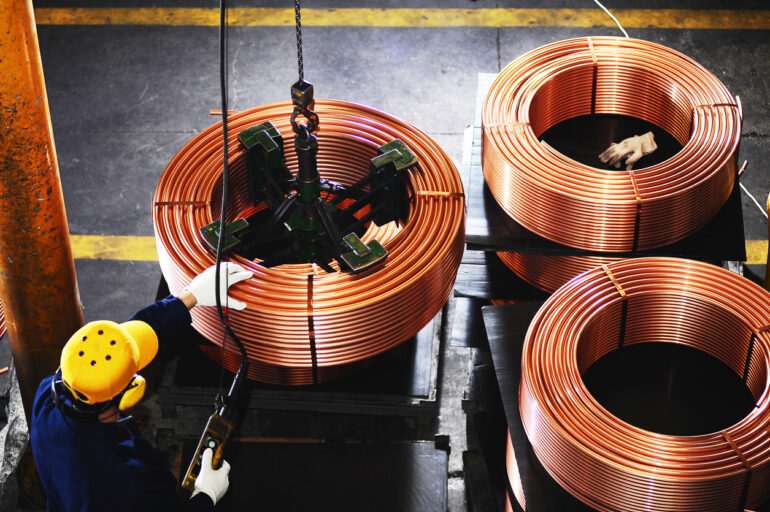
UBS has raised its copper price forecasts for the second time this year, now targeting $14,000 per metric tonne by September 2026 and introducing a fresh June 2027 target of $15,500/mt, as the bank warns that a widening supply deficit will keep the industrial metal in structural shortage through the end of the decade.
London Metal Exchange copper briefly exceeded $14,000/mt this month, before settling back to $13,497/mt. The metal has gained approximately 18% year-to-date, outpacing most other base metals and commodities indices, with the copper futures chart above very much showing an ‘up and to the right’ pattern. The sustained rally has lifted copper stocks across the mining sector, with major producers seeing gains even despite broader equity market volatility. The UBS forecast upgrade, which represents a roughly 13% increase to the bank’s previous 2026 estimate, has reinforced bullish positioning across commodity trading desks and mining equity funds.
What is driving the copper price?
UBS now estimates the 2026 global copper market will face a deficit of 520,000 metric tonnes, more than doubling from an expected 203,000mt shortfall in 2025. This upward revision reflects three compounding supply constraints that have emerged or intensified in recent months.
First, China’s sulphuric acid export restrictions, implemented in May 2026, have squeezed smelter economics across Asia. Sulphuric acid is a critical by-product of copper smelting and an essential reagent for leaching operations at many mines. The export curbs have driven domestic Chinese acid prices sharply higher while reducing availability for smelters in neighbouring countries, forcing some operations to cut output or pay premium prices for alternative sources.
Top Australian Brokers
- Pepperstone - Top Australian broker - Read our review
- eToro - Invest in ASX and international shares - Read our review
Second, concentrate supply remains exceptionally tight. Benchmark treatment and refining charges for 2026 contracts collapsed to $0/mt, down from approximately $25/mt in 2025 agreements. Spot TCRCs have fallen below negative $100/mt, meaning smelters are effectively paying miners to secure feed material rather than charging for processing services. This extreme inversion signals fierce competition among overcapacity smelters for scarce concentrate and represents one of the tightest concentrate markets on record.
Third, project delays continue to push out new supply. Freeport-McMoRan’s Grasberg underground expansion in Indonesia, once expected to ramp in 2026-2027, has been delayed to early 2028. Other major operations including Quebrada Blanca II in Chile and Kamoa-Kakula in the Democratic Republic of Congo have faced operational setbacks, while Cobre Panamá remains offline following its 2023 closure.
On the demand side, UBS forecasts global copper consumption will grow 2.8% in 2026, driven by grid infrastructure investment, electric vehicle adoption and data centre buildout. By contrast, refined copper supply is projected to expand just 1.7%, locking in a widening deficit profile. The bank’s demand growth estimate sits above some peers and reflects an assumption that structural electrification trends will offset any cyclical weakness in traditional manufacturing or Chinese property markets.
The Call, and View Across The Street
UBS has explicitly recommended long copper positions, viewing any pullbacks toward $12,800-13,000/mt as attractive entry opportunities. The bank also favours volatility-selling strategies to the downside, suggesting it views sustained corrections below current levels as unlikely given the supply fundamentals. The UBS view aligns with recent upgrades from other major banks, though price targets vary.
Bank of America now forecasts copper averaging $11,313/mt in 2026 and $13,501/mt in 2027, with peaks near $15,000/mt.
Deutsche Bank raised its 2026 forecast to $10,600/mt with peaks above $11,000/mt in the first half.
Goldman Sachs maintains a more conservative profile at approximately $11,400/mt for 2026, warning that parts of the recent rally have been driven by speculative positioning rather than purely fundamental tightness.




