



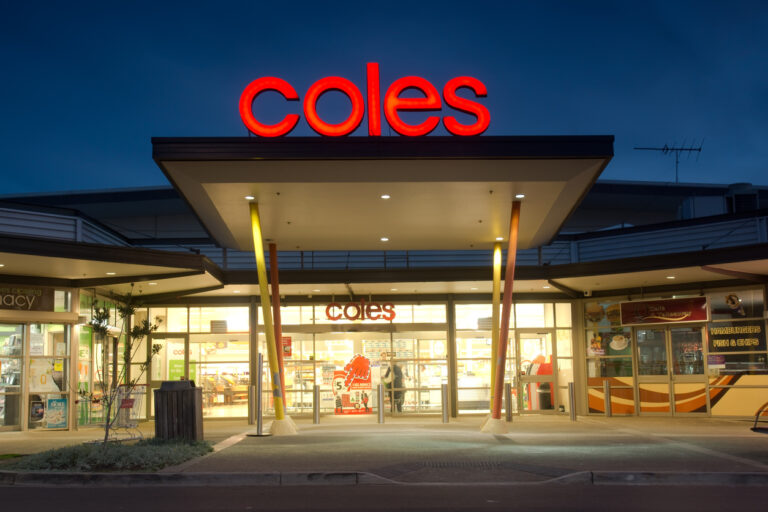
Coles Group shares (ASX:COL) have fallen back below the A$24 level at the start of September, as yet another attempt to sustain a breakout meets selling pressure. The pullback marks out a clear line in the sand for the stock, as strong FY26 earnings bumps heads with softer early-FY27 signals, competitive pressure from Woolworths, and an unresolved overhang of cost and regulatory risk.
The Coles share price closed out at A$23.68 on 1 September, down 1.5% on the day, leaving the stock roughly 11% higher year-to-date but stuck beneath a well-defined ceiling. A glance at the 1 year chart will make it easy enough to spot, as over the past three months the shares have tested breaks above A$24 in June, July and August, only to be sold back into the prior range each time.
Recent Financials
The backbone of the bull case remains Coles’ FY26 result, which beat expectations on an underlying basis. Group sales revenue came in at approximately A$45.6 billion, up 2.8% year-on-year. EBIT excluding significant items rose 9.9% to around A$2.32 billion, while net profit after tax excluding significant items climbed 13.7% to roughly A$1.26 billion, modestly ahead of consensus. The board lifted total fully franked dividends by 13% to 78 cents per share, a signal of confidence in cash generation and balance-sheet strength.
Supermarkets did the heavy lifting. Divisional sales revenue rose 3.7%, or 5.1% excluding tobacco, with EBIT up 12.2% and gross margin expanding by roughly 37 to 43 basis points. Management credited a shift away from lower-margin tobacco, growth in the Coles 360 retail media business, and productivity gains from automation and distribution centre investment. Supermarkets eCommerce sales grew about 26% to A$5.6 billion, reinforcing the view that digital is becoming a profitable growth engine rather than a cost centre.
The statutory picture was less clean. Coles booked around A$235 million in pre-tax significant items, or A$165 million after tax, linked to a Federal Court judgment in September 2025 involving Fair Work Ombudsman proceedings over staff underpayment. As a result, statutory NPAT rose only about 1% despite the strong underlying performance. This followed an earlier half-year result in which NPAT fell 11.3% to A$511 million, partly reflecting an underpayment liability of roughly A$269 million, which triggered a sell-off of as much as 9% intraday.
Top Australian Brokers
- Pepperstone - Top Australian broker - Read our review
- eToro - Invest in ASX and international shares - Read our review
Guidance Mixed
Early FY27 trading has sent mixed messages. On one hand, Coles indicated supermarket sales growth across the first eight weeks of the new financial year is broadly consistent with the fourth-quarter FY26 pace, with eCommerce penetration rising to around 15.7%, in line with consensus expectations for FY27 sales growth of about 3.5%. On the other hand, a separate report described the start to the year as softer than some analysts expected, with Woolworths’ aggressive collectibles promotion weighing on supermarket sales.
The segment divergence also persists. While supermarkets deliver above-market growth, the Liquor division saw sales revenue fall about 3.3%, pressured by subdued consumer sentiment, tough prior-year comparables and heavier promotional activity. Coles has launched a multi-year repositioning program for Liquor, aimed at improving integration with supermarkets, optimising the store network and simplifying the offer. Separately, the company is understood to be exploring acquisitions in specialty pet retail, an adjacent category with potential supply chain and merchandising synergies, while continuing to invest heavily in supply chain automation.
What Next?
From a technical standpoint, the A$24–24.50 band is the line that matters for the time being. A decisive break and hold above it would likely require fresh catalysts, such as confirmation that FY27 sales momentum is tracking at or above the roughly 3.5% consensus, evidence that the Liquor repositioning is stabilising that division, or concrete progress on automation-driven efficiency gains. Failure to hold above nearer-term support around A$23 would raise the risk of a deeper retracement toward the low-A$22s, levels seen after previous disappointing updates.
With Coles shares having added 10.97% YTD, yet remaining 1.66% in the red on a trailing twelve month basis there has been a period of consolidation higher, after a few strong years. To keep things in perspective, we will end by zooming out to the 5 year chart, one which continues to have Coles up 33.48%.
For now, it looks like a cautious tape. Coles has delivered a genuine earnings upgrade cycle, a bigger dividend and a credible automation and digital strategy, yet the repeated failure to hold above A$24 shows markets are unwilling to pay much more without clearer proof that FY27 growth and margin resilience can extend that momentum. Macro updates are not exactly helping bulls, yet there remains plenty to keep both sides interested.
Bull Case:
- Underlying FY26 earnings beat, with NPAT up 13.7% and dividends raised 13%.
- Supermarkets margin expansion, 26% eCommerce growth and automation underpin structural story.
- Defensive earnings and resilient trading support another attempt at breaking A$24 resistance.
Bear Case:
- Repeated failures above A$24 suggest markets see valuation as close to best-case.
- Woolworths promotions and a softer FY27 start threaten supermarket sales momentum.
- Wage remediation, liquor weakness and regulatory scrutiny continue to cap upside.




