
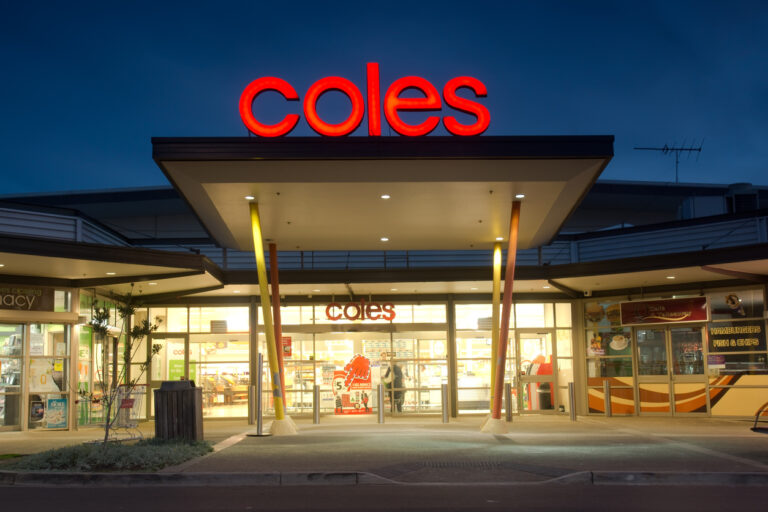
Coles Group shares (ASX:COL) fell 1.75% on Monday to move into negative territory YTD (-0.28%), as a downgrade from a previously bullish analyst adds to what has been a difficult week or so in the market.
RBC downgraded Coles to Sector Perform from Outperform following a disappointing first-quarter trading update, cutting its price target from A$25.00 to A$23.00 as slowing sales growth, rising costs, and intensifying competition from Woolworths all weigh on sentiment.
The downgrade comes hot on the heels of six straight negative sessions, taking 13.32% from Coles’ share price. Prior to the sell-off, Coles had been a relative outperformer among ASX consumer staples names, buoyed by defensive sector rotation and expectations of steady earnings growth through the second half of the calendar year.
Fundamentals shift tone at Coles
Coles reported total group revenue of A$11.21 billion for Q1 FY27, representing growth of 2.2% on the prior corresponding period. Supermarket sales rose 3.6% to A$10.32 billion, but the more closely watched comparable store sales figure came in at just 2.7%, a meaningful deceleration from the 4.6% growth recorded in the same period a year earlier. RBC had forecast 3.2% comparable growth, while broader market consensus sat closer to 3.5%, making the miss notable on both counts.
Top Australian Brokers
- Pepperstone - Top Australian broker - Read our review
- eToro - Invest in ASX and international shares - Read our review
The more damaging element of the update, however, was the earnings guidance. Management flagged that first-half FY27 Supermarket EBIT is expected to remain flat year-on-year at approximately A$1.23 billion. That compares starkly with consensus expectations for mid-to-high single-digit EBIT growth in the range of 7% to 8%, and RBC calculated the implied downgrade to consensus forecasts at around 6%.
The flat profit outlook reflects a combination of deliberate strategic choices and external pressures. Coles has committed approximately A$46 million to its refreshed Every Day Price initiative, a programme designed to rebuild consumer value perception ahead of the critical Christmas trading window. The investment involves expanded promotional activity and targeted price reductions across key categories, a response to what management acknowledged has been a weakening in how shoppers perceive Coles’ value credentials relative to competitors.
Those competitive pressures are quantifiable, with Woolworths reporting Australian food sales growth of 6.9% in the same quarter, more than double Coles’ comparable figure, confirming that market share has been shifting in favour of the larger rival.
Bright spots
There were a couple of bright spots in the print, as online supermarket sales surged 22.9% to A$1.62 billion, lifting e-commerce penetration to 15.7% of total supermarket revenue, a meaningful structural shift that positions the business well for changing consumer shopping habits.
Own-brand product sales grew 4.3% overall, with the premium Coles Finest range expanding at a considerably faster 13.3%, pointing to resilience in higher-margin private-label categories. Management also noted that long-term automation investments across the distribution network are beginning to deliver structural efficiency gains, though the financial benefit of those initiatives is expected to be more visible in outer years.
What lay ahead
RBC’s downgrade to Sector Perform effectively removes its active buy recommendation on the stock, placing Coles in a neutral holding pattern at the broker level. The revised A$23.00 price target implies modest upside from current levels but reflects the reduced earnings expectations. Notably, RBC maintained a slight relative preference for Coles over Woolworths on a longer-term basis, suggesting the firm views the competitive dynamics as potentially stabilising once the Christmas pricing strategy takes effect. The broker cautioned, however, that margin dilution and operating deleverage remain live risks if Coles is forced to sustain elevated promotional investment beyond the holiday period.
From a technical perspective, the six-session losing streak and the breach of the stock’s year-to-date breakeven level are signals that markets are repositioning ahead into the end of the year. The structural positives, including e-commerce growth, own-brand expansion, and automation-driven efficiency, remain intact, but are not strong enough to keep the stock up at highs.
Bull Case:
- Online sales surged 22.9%, lifting e-commerce penetration to 15.7% of supermarket revenue.
- Coles Finest premium own-brand range growing 13.3%, supporting higher-margin private-label mix.
- Early Christmas price investment could recover market share before peak seasonal trading volume.
Bear Case:
- Woolworths’ 6.9% food sales growth versus Coles’ 2.7% signals accelerating competitive market share loss.
- Flat H1 FY27 Supermarket EBIT guidance represents a 6% implied downgrade to consensus forecasts.
- A$46 million pricing investment and rising fuel costs will compress margins throughout FY27.