



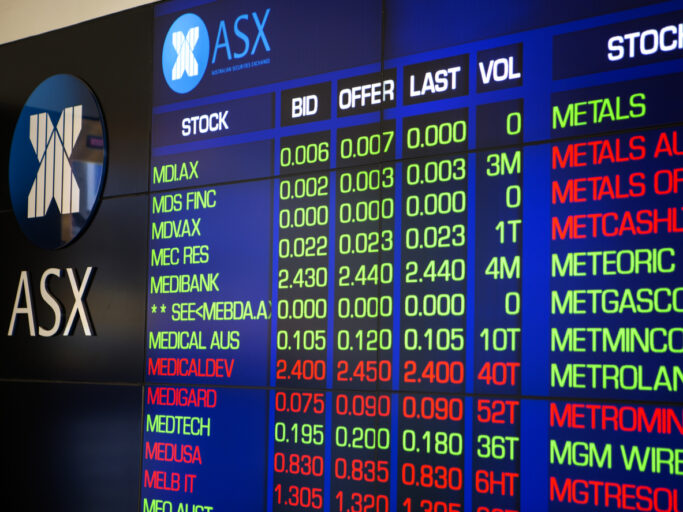
ASX Ltd shares (ASX:ASX) are trading more than than 12% higher today, after reporting a solid FY26 result that saw the company perhaps crucially opt not to raise its already-elevated expense and capital expenditure forecasts for the year ahead.
The ASX share price currently sits 12.56% higher on the day at A$62.58, marking one of the stock’s strongest single-day performances in recent years. Today’s move takes the stock back toward levels last seen before May’s guidance shock, when shares plunged approximately 10% in a single session after management outlined the scale of spending required through FY27 and FY28.
The sharp recovery reflects a material reset in sentiment. Markets had positioned defensively heading into the result, braced for the possibility that cost guidance might be ratcheted higher yet again. Instead, the company delivered metrics slightly ahead of consensus and held the line on its expense outlook, triggering a relief rally that pushed the stock toward the upper end of recent broker price targets.
Core Financial Performance and FY27 Guidance
ASX reported FY26 results that were described by analysts as “fairly in line” with expectations, with most key metrics including revenue and underlying earnings coming in 1-2% ahead of consensus forecasts. The result demonstrated that the exchange operator’s core franchise remains resilient despite the elevated cost base, with strong activity across cash equities, derivatives, and clearing and settlement services.
More importantly for markets, ASX reaffirmed its FY27 guidance without any upward revision. Total expense growth is still expected to land in the 18-21% range compared to FY26, driven by technology modernisation, the expanded Accelerate Program responding to ASIC’s inquiry into the failed CHESS replacement project, and growth initiatives. Operating expense growth excluding depreciation and amortisation is forecast at 13-16% for FY27. Capital expenditure guidance was also unchanged at A$180-200 million for FY27, up from the A$170-180 million spent in FY26 but consistent with the framework laid out in May.
Top Australian Brokers
- Pepperstone - Top Australian broker - Read our review
- eToro - Invest in ASX and international shares - Read our review
The company pointed to a solid operating backdrop heading into the new financial year. Operating revenue for the year to date through 30 April 2026 reached A$1.03 billion, up 12.5% year-on-year, with growth across all four divisions. Strength in interest-rate futures, cash equities trading, and clearing volumes underpinned the performance, while management commentary highlighted a positive outlook for listings activity and the IPO pipeline.
UBS modelling from June had already incorporated FY27 total expense growth of approximately 19.6%, sitting comfortably in the middle of the guidance range. The fact that ASX did not push those numbers higher appears to have been the critical factor in today’s rally, particularly given how severely the stock was punished when the original May guidance was released.
Why Markets Were So Relieved
The May 26 guidance update had sent shockwaves through the ASX shareholder base. At that time, the company laid out a multi-year investment programme with expense growth of 18-21% in FY27 and capital expenditure remaining elevated at A$170-190 million even in FY28. The market’s immediate reaction was brutal, with shares falling roughly 10% on the day to around A$52.27. Retail and institutional commentary framed the update as evidence of a structural margin problem, with a regulated monopoly operator now facing double-digit cost growth for multiple years.
Morningstar published analysis titled “ASX: Expense Growth Guidance Scares Investors,” capturing the prevailing mood. The concern was not just the absolute level of spending but the duration and potential for further cost overruns, particularly given the company’s troubled history with the CHESS replacement project. ASIC had commenced legal proceedings in August 2024 regarding representations made about that project, with a trial scheduled for June 2026, adding to the regulatory and execution risk premium markets were demanding.
Yet even at the depths of that sell-off, some analysts argued the market had overreacted. UBS emerged as notably bullish, maintaining a price target around A$62 when the stock was trading in the mid-to-high A$40s. The bull case rested on the view that ASX’s core franchise—a quasi-monopoly exchange and clearing house with strong pricing power—remained fundamentally sound, and that once the peak investment phase passed, margins and cash generation would recover.
Today’s price action suggests markets are now willing to give that thesis more credence. The combination of a clean FY26 print, no incremental bad news on costs, and evidence of strong underlying revenue momentum has shifted sentiment from “open-ended cost spiral” to “time-bounded investment phase with a visible horizon.”
Technology Modernisation
The elevated spending is directly tied to ASX’s efforts to modernise its technology infrastructure and satisfy regulatory commitments following the CHESS debacle. The Accelerate Program, explicitly referenced in guidance documents, forms part of the company’s response to ASIC’s inquiry and aims to rebuild trust in the exchange’s market infrastructure.
Management frames the expenditure as necessary to deliver new products, improve system resilience, and support long-term growth. If executed successfully, the investment should translate into a more robust platform capable of supporting higher volumes and potentially commanding better pricing. However, execution risk remains material. Large, complex technology programmes in financial market infrastructure are notoriously difficult to deliver on time and on budget, and any slippage could see costs overshoot even the already-elevated guidance.
The ASIC proceedings, while not directly affecting day-to-day operations, serve as a constant reminder of the reputational and regulatory challenges ASX faces. Markets will be watching closely for any updates on the legal matter and for evidence that the Accelerate Program is delivering tangible improvements in operational resilience and customer satisfaction.
What Next For ASX?
Price Targets
The sharp rally also reflects how far sentiment had deteriorated and how defensively markets were positioned. After the May guidance shock, ASX was trading at levels that implied significant ongoing margin compression and limited confidence in management’s ability to control the cost base. Retail commentary in June and July debated whether the de-rating had gone too far for a high-quality, monopoly-like asset.
The Street’s current consensus target of $56.16 sits more than 5% below today’s closing price, with analysts not yet shifting following the print, if they are to. The key question for valuation now is whether FY27 truly represents the peak of the investment cycle, as management suggests, or whether elevated spending will persist into FY28 and beyond. The company has flagged FY28 capex of A$170-190 million, still well above historical norms, indicating that the cash flow headwind will not disappear overnight. However, if revenue growth continues at a double-digit pace, the impact on margins and returns may prove more manageable than feared.
On the technical side, today’s surge has pushed the stock above its upper Bollinger Band, which signals that the move is stretching beyond the recent trading range. That kind of extension can reflect genuine demand or it can mark a point where the rally becomes harder to sustain without follow-through buying.
Today’s bounce marks a significant sentiment inflection for ASX, with markets choosing to reward management for holding the line on costs rather than punishing the absolute level of spending. Yet with expense growth still running at nearly 20% and capital expenditure elevated for at least another two years, the path to sustained margin recovery remains long and uncertain, leaving ample room for both bulls and bears to find validation in the months ahead.
Bull Case:
- Core monopoly franchise intact with strong pricing power and volume leverage
- Revenue growth of 12.5% year-on-year provides buffer against elevated costs
- FY27 cost guidance reaffirmed without further increase signals peak investment phase
- Strong listings pipeline and derivatives activity support continued top-line momentum
- Prior de-rating left valuation at attractive levels for quality infrastructure asset
Bear Case:
- Expense growth of 18-21% in FY27 pressures margins for extended period
- Elevated capex of A$180-200 million in FY27 constrains cash returns to shareholders
- Execution risk on technology modernisation and Accelerate Program remains high
- ASIC legal proceedings and regulatory scrutiny create ongoing reputational overhang
- Macro downturn in trading volumes or listings could undermine revenue assumptions




