



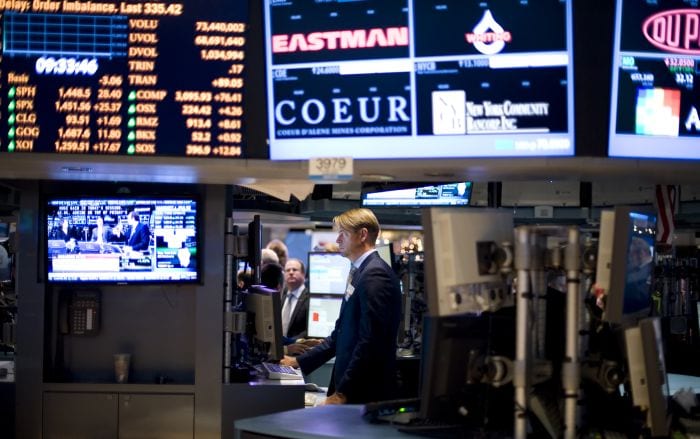
The Nasdaq Composite declined, along with Wall Street’s other major indices, on Thursday as markets digested a mixed bag of earnings from technology heavyweights, with strong revenue growth offset by concerns over profitability, strategic pivots, and escalating investment requirements.
Nasdaq Composite Slumps
Meta Platforms shares surged 7.9% during Thursday’s session after initially jumping 10.9% in after-hours trading to $741.88 following its fourth-quarter earnings release. The social media giant’s performance stood in stark contrast to other tech bellwethers. Tesla shares declined 2% despite reporting beats on both revenue and earnings, while Microsoft experienced the sharpest selloff, plunging 11.5% even after exceeding analyst expectations across key metrics. The divergent price action underscored markets’ shifting focus from headline beats to underlying business fundamentals and future growth trajectories.
Top Australian Brokers
- Pepperstone - Top Australian broker - Read our review
- eToro - Invest in ASX and international shares - Read our review
Major Tech Earnings Fail to Impress
Meta Platforms delivered robust fourth-quarter results that showcased the enduring strength of its advertising business. Revenue climbed 24% year-over-year to $59.89 billion, surpassing the $58.5 billion analyst consensus. Earnings per share reached $8.88, up from $8.02 in the prior-year period. However, the results came with a significant caveat: operating costs surged 40% to $35.15 billion, driven by aggressive investments in artificial intelligence infrastructure and talent acquisition. For the first quarter of 2026, Meta projected revenue between $53.5 billion and $56.5 billion, exceeding analyst forecasts and signaling continued momentum in its core advertising franchise.
Tesla’s earnings report painted a more complicated picture of the electric vehicle maker’s transformation. The company posted its lowest annual profit since the pandemic, with net income plummeting 46% to $3.8 billion in 2025. The decline reflected Tesla’s loss of its position as the world’s top EV manufacturer and the impact of sales boycotts. Despite introducing more affordable models, profits declined for the second consecutive year. The company announced plans to more than double capital expenditures to $20 billion in 2026, with a strategic pivot toward AI, robotaxis, and humanoid robots taking center stage. Tesla halted production of its Model S and X vehicles to repurpose a Fremont factory for robot manufacturing and disclosed a $2 billion investment in CEO Elon Musk’s AI venture, xAI, raising conflict-of-interest questions among shareholders.
Microsoft’s fiscal second-quarter results demonstrated continued execution, with revenue reaching $80.3 billion, a 13.6% year-over-year increase. Earnings per share of $2.48 topped analyst expectations. Despite these positive figures, markets reacted negatively to the report, with the stock’s 11.5% decline suggesting concerns about future growth prospects, intensifying competition in cloud computing and AI, and the potential impact of massive infrastructure investments on profit margins.
Nasdaq Composite Outlook and Analysis
The divergent market reactions to Thursday’s earnings reports highlight a critical shift in how markets are evaluating technology companies. Strong revenue growth and earnings beats are no longer sufficient to drive share price appreciation when accompanied by surging costs or uncertain strategic transitions. Meta’s ability to maintain share price gains despite a 40% increase in operating costs suggests markets remain confident in the company’s capacity to monetize its AI investments through enhanced advertising products and user engagement.
Tesla faces perhaps the most challenging path forward among the three companies. The automaker aims to roll out robotaxi services in several U.S. cities and launch its Cybercab model, but CEO Elon Musk’s history of missed deadlines has created skepticism about these timelines. Analysts remain divided, with some anticipating Tesla will dominate the emerging robotaxi market while others cite outdated product lineups and brand damage linked to Musk’s political controversies. Positive indicators include a jump in energy storage revenue and rising gross profit margins, suggesting some business segments are gaining traction.
Microsoft’s sharp selloff, despite solid fundamentals, may reflect broader concerns about the sustainability of growth rates in cloud computing and whether the company’s substantial AI investments will generate sufficient returns to justify their cost. The technology sector’s competitive dynamics are intensifying, with multiple players vying for dominance in artificial intelligence and cloud infrastructure.
Analyst Summary
Bull Case
- Meta’s 24% revenue growth demonstrates continued advertising market dominance
- Tesla’s robotaxi pivot could unlock massive autonomous vehicle market opportunity
- Microsoft’s cloud and AI infrastructure investments position for long-term growth
Bear Case
- Meta’s 40% operating cost surge threatens future profit margin compression
- Tesla’s 46% profit decline and strategic uncertainty raise execution risk concerns
- Microsoft’s growth deceleration amid rising competition justifies valuation reset pressure
Thursday’s earnings season snapshot reveals that technology investors are demanding more than just quarterly beats—they want clear paths to profitable growth and confidence that massive capital expenditures will translate into sustainable competitive advantages, a higher bar that even industry leaders are struggling to clear as they navigate the expensive transition to an AI-driven future.




