



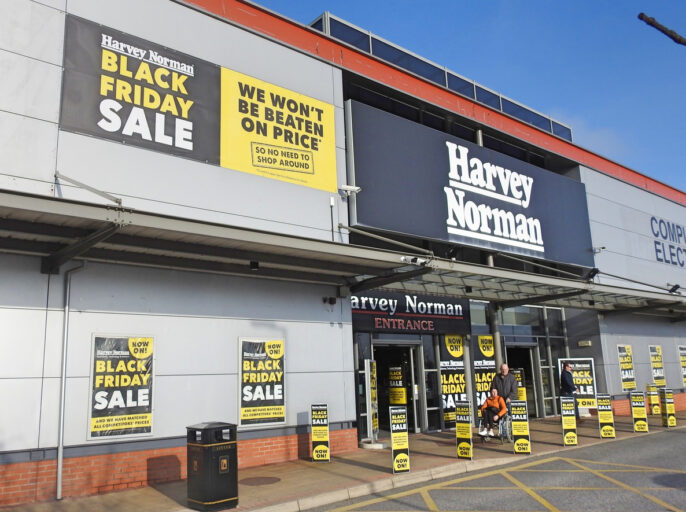
Harvey Norman shares (ASX: HVN) closed 1.32% higher at A$4.59 on Thursday, rebounding from fresh 52-week lows of A$4.48 as technical support and structural buying interest emerged after a brutal 34.5% year-to-date drawdown that has slashed the retailer’s market capitalisation to A$5.72 billion.
The modest recovery on the day comes after months of relentless selling pressure that accelerated following the company’s February half-year results and has persisted through April despite an absence of fresh negative company-specific news. The Harvey Norman share price, which traded as high as A$7.70 in late 2025, has now retraced to levels not seen since early 2023, compressing valuations to a trailing price-to-earnings ratio around 10 times and pushing the fully franked dividend yield above 6%.
Solid Fundamentals Weaker Under The Surface
Harvey Norman’s 1H26 results, released on 27 February 2026, initially appeared strong on the surface. Profit before tax rose approximately 16.5% to A$466.3 million, while net profit after tax climbed roughly 15% to A$321.9 million. The company lifted its interim dividend by 20% to 14.5 cents fully franked, and system-wide sales increased 6.9% year-on-year to A$5.16 billion, with Australian franchisee sales up 4.8% and company-operated offshore sales surging 11.6%.
Yet markets sold the stock down sharply on the day, with shares falling approximately 8-9% to close around A$5.76. The negative reaction reflected concerns over the quality and sustainability of the earnings beat, particularly given weaker operating cash flow dynamics. Operating cash flow declined roughly 12% year-on-year to A$392.9 million, impacted by higher tax payments, increased financing arrangements for franchisees, elevated inventory levels, and a notable A$95 million drawdown on the company’s syndicated credit facility compared to a A$105 million repayment in the prior corresponding period.
The cash flow deterioration and fresh debt drawdown undermined the prevailing bull narrative of Harvey Norman as a cash-rich, conservatively geared business entering a period of sustained earnings growth. Markets began questioning whether the elevated profit levels represented cyclical peaks driven by artificial intelligence and technology-related electronics demand rather than sustainable strength in core furniture and appliance categories tied to housing turnover and discretionary consumer spending.
Top Australian Brokers
- Pepperstone - Top Australian broker - Read our review
- eToro - Invest in ASX and international shares - Read our review
The sell-off intensified through March and April as housing-linked retailers came under broader sector pressure. The persistent weakness reflected mounting caution around household spending, housing market activity, and big-ticket discretionary purchases, with markets effectively treating Harvey Norman as a leveraged play on household wealth and property turnover regardless of recent reported results.
Against this backdrop of macro-driven selling, one structural factor has provided a potential floor: the company’s extended on-market share buyback programme. Originally scheduled to conclude in November 2025, the board extended the authorisation through to 23 November 2026, maintaining flexibility to repurchase shares on-market. As the stock has compressed into the mid-A$4 range, buybacks become increasingly accretive to per-share earnings and dividends, and the presence of a known corporate bid has supported the technical narrative that support is forming near recent lows.
High insider ownership adds another layer to the support thesis. Founder and executive chairman Gerry Harvey and associated parties control approximately 40% of the company, creating strong alignment between management and minority shareholders. This concentrated ownership structure signals that insiders are heavily exposed to the same price decline and dividend stream, lending credibility to capital allocation decisions including the extended buyback programme.
What Next For Harvey Norman?
The bull case for Harvey Norman from current levels rests on the view that FY25 and 1H26 results demonstrated the operating leverage and earnings power of the franchise-plus-owned-stores-plus-property model, and that the market has overshot to the downside in discounting a severe cyclical downturn. Bulls point to double-digit profit growth, margin expansion, strong offshore contributions, and management commentary flagging positive trading momentum into early 2026. They argue that any stabilisation in macro conditions whether from interest rate cuts, improved housing turnover, or resilient consumer confidence, could deliver strong asymmetric upside from these depressed levels.
The bear case centres on the concern that recent earnings represent near-peak cyclical profits for a housing-levered retailer heading into a softer consumer environment. Bears highlight the weaker operating cash flow, increased reliance on debt facilities, and the risk that elevated earnings and dividends may prove unsustainable if discretionary demand deteriorates further. They note that the stock’s underperformance relative to a still-resilient broader index underscores how macro fears are trumping micro strength, and caution that the A$4.5 support zone could fail if economic conditions worsen or if management leans more aggressively on leverage to fund buybacks and capital expenditure into a downturn.
Bull Case:
- Trades at 10x earnings with 6%+ fully franked yield at multi-year lows
- Active buyback through November 2026 provides mechanical support and signals board confidence
- Offshore operations and AI/tech demand provide growth vectors beyond domestic housing cycle
- Operating leverage demonstrated: sales up 7% drove profit up 16.5% in 1H26
- 40% insider ownership strongly aligns management with minority shareholder value creation
Bear Case:
- Operating cash flow down 12% and A$95m facility drawdown signal balance sheet pressure
- Earnings likely at cyclical peak; housing and discretionary demand headwinds mounting into FY27
- 8-9% sell-off on “good” February result shows market pricing in earnings normalisation downward
- Sector-wide weakness in housing-linked retailers reflects macro fears trumping company-specific strength
- Concentrated ownership and governance structure may limit strategic flexibility and institutional appeal
Whether Thursday’s modest bounce from A$4.48 to A$4.59 marks the beginning of a sustained recovery, and a solid support level, or merely a brief respite in a longer downtrend will likely depend on the next set of catalysts: upcoming macroeconomic data on housing and consumer spending, any updated trading commentary from management, and the full-year FY26 result due later in 2026. For now, Harvey Norman shares appear to have found tentative support as value buyers weigh depressed valuations and structural buying interest against lingering concerns about the sustainability of recent earnings and the trajectory of Australia’s discretionary consumer cycle.




