



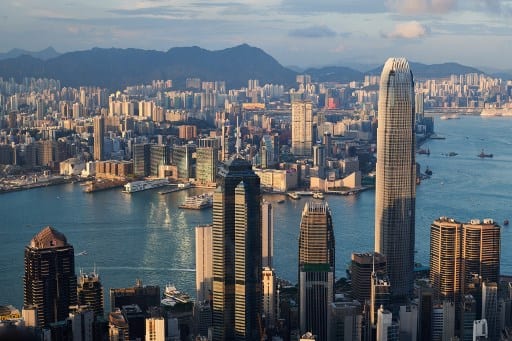
Hong Kong’s benchmark equity index bounced Monday despite oil prices hovering near $100 per barrel, as stronger-than-expected Chinese economic data provided a tactical boost to sentiment amid escalating geopolitical tensions in the Middle East.
The Hang Seng Index closed 1.45% higher at 25,834.02, outperforming most regional peers as markets digested the dual forces of China’s economic resilience and mounting energy supply concerns. Mainland China’s CSI 300 finished essentially flat at 4,671.56, suggesting more cautious positioning among domestic traders.
Japan’s Nikkei 225 slipped 0.13% to 53,751.15, weighed down by energy import concerns, while South Korea’s Kospi added 1.14% to 5,549.85, supported by technology and export-oriented names.
The divergence in regional performance underscored the competing narratives shaping Asian equities: fundamental economic data versus macro risk premiums tied to the U.S.-Iran conflict.
Top Australian Brokers
- Pepperstone - Top Australian broker - Read our review
- eToro - Invest in ASX and international shares - Read our review
Energy Markets and Geopolitical Tensions
U.S. crude oil traded near $98.70 per barrel in Asian hours, while Brent crude, the international benchmark, rose 0.48% to $103.70. The elevated prices follow President Donald Trump’s Friday order authorizing strikes against Iranian military assets on Kharg Island, a strategically critical oil export hub that handles the majority of Iran’s crude shipments. U.S. Ambassador to the United Nations Mike Waltz reiterated warnings of further attacks on Iranian energy infrastructure over the weekend.
The conflict has raised concerns about prolonged disruptions to global energy supplies, particularly if the Strait of Hormuz, through which approximately 20% of the world’s oil passes, remains constrained. Goldman Sachs estimates the energy price surge could reduce global GDP by roughly 0.3% over the next twelve months while adding 0.5% to 0.6% to headline inflation. The investment bank noted that higher natural gas prices would compound inflationary pressures and growth headwinds, especially across Europe and Asia, with risks tilted toward larger impacts if shipping routes remain compromised.
Oil prices have exhibited extreme volatility in recent sessions, with recent whipsaw action reflecting market uncertainty about the conflict’s duration and ultimate impact on global energy balances.
China Economic Data Beats Expectations
The Hang Seng’s outperformance was anchored by Chinese economic indicators that exceeded analyst forecasts. Retail sales for the January-February period rose 2.8% year-over-year, surpassing the consensus estimate of 2.5%, though marking a deceleration from the 4% growth recorded in early 2025. The slowdown in consumption growth highlights ongoing challenges in China’s domestic demand recovery despite government stimulus efforts.
Industrial output delivered a more robust surprise, climbing 6.3% compared with expectations for a 5% increase. The strength in manufacturing has been concentrated in export-oriented sectors, with resilient external demand from European and Southeast Asian markets offsetting domestic headwinds. The production data suggests China’s industrial base continues to benefit from its role in global supply chains, particularly as Western economies seek to diversify sourcing while maintaining cost efficiency.
The mixed signals of strong production coupled with softer consumption paint a picture of an economy still reliant on external demand engines rather than a fully balanced domestic-led expansion. Markets interpreted the data as evidence that China’s policy support measures are gaining traction, at least in specific segments, providing fundamental justification for bargain hunting in heavily discounted Hong Kong-listed equities.
Energy producers, refiners, and defense contractors stand to benefit from elevated oil prices and heightened security spending, enjoying pricing power and cash flow windfalls. On the other hand, transportation, aviation, shipping, and manufacturing firms face margin compression from higher input costs, particularly in energy-importing economies such as Japan, South Korea, and much of Southeast Asia.
Goldman Sachs and other major investment banks have been revising oil price forecasts upward, increasingly modeling scenarios where Brent crude remains above $100 per barrel if Strait of Hormuz disruptions persist. Such an environment would likely trigger a stagflationary impulse that historically compresses equity valuations and prompts earnings downgrades, particularly for cyclical and consumer-facing companies.
The International Energy Agency has characterized the current supply disruption as among the largest in modern history, with diesel and jet fuel markets experiencing acute stress. Shipping and aviation costs are rising due to higher fuel expenses and elevated insurance premiums for routes near conflict zones, creating ripple effects across European-Asian trade corridors.
China-specific risks remain in focus beyond the immediate geopolitical shock. Property sector weakness, local government financing pressures, and questions about the sustainability of export-led growth continue to cap enthusiasm for aggressive positioning in Chinese equities. The retail sales deceleration in the latest data serves as a reminder that domestic consumption, critical for China’s long-term rebalancing, remains fragile.




