



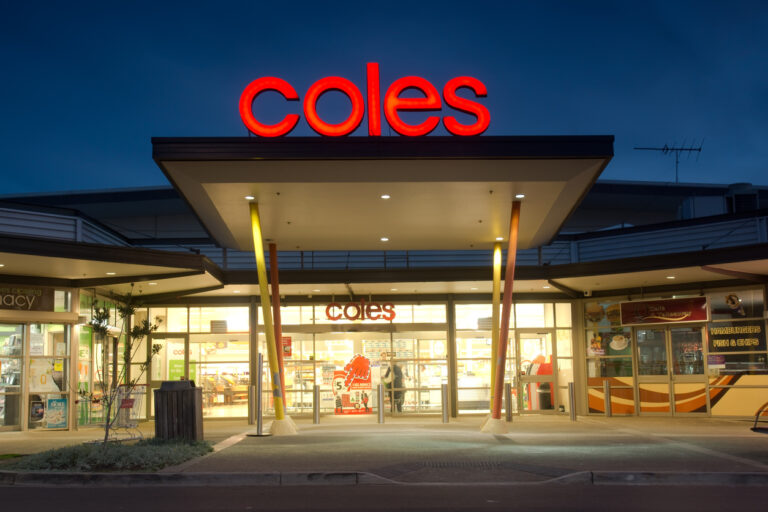
Coles Group shares (ASX:COL) fell 2.84% on Tuesday as the supermarket giant went ex-dividend for its 41-cent interim payout, capping a difficult six months that has seen the stock retreat 13.51% from its September 2025 level amid regulatory headwinds and mixed earnings optics.
The Coles Group share price closed lower, as investors adjusted for the fully franked interim dividend of 41 cents per share, with the record date set for 11 March and payment due 30 March. The mechanical drop broadly reflects the dividend value leaving the share price, though the move extends a broader slide that has erased nearly A$2 billion in market capitalisation since the stock hit all-time highs six months ago.
Fundamentals
Markets have cooled on Coles despite the company delivering double-digit underlying profit growth in its first-half FY26 results released 27 February. Group sales revenue rose 2.5% to A$23.6 billion for the six months ended December 2025, with the core supermarkets division posting revenue of A$21.4 billion, up 3.6% on a reported basis and 6.1% excluding tobacco. Earnings before interest and tax climbed 10.2% to A$1.231 billion, while net profit after tax excluding significant items jumped 12.5% to A$676 million, supported by 55 basis points of margin expansion in supermarkets to 5.8%.
Yet statutory net profit told a starkly different story, falling 11.3% to A$511 million after Coles booked a A$235 million pre-tax provision linked to a September 2025 Federal Court ruling in a Fair Work Ombudsman case concerning historical underpayment of salaried store employees. The provision, equivalent to A$165 million after tax, turned what was otherwise a strong underlying performance into a headline profit decline that triggered the stock’s sharpest single-day fall since March 2020, with shares plunging around 6% on heavy volume of more than 14 million shares traded.
Top Australian Brokers
- Pepperstone - Top Australian broker - Read our review
- eToro - Invest in ASX and international shares - Read our review
The supermarket operator also faces ongoing legal uncertainty from Australian Competition and Consumer Commission proceedings over alleged misleading discount pricing practices involving 245 products marketed under its “Down Down” promotional banner between February 2022 and May 2023. The regulator alleges Coles temporarily increased prices before advertising discounts that were illusory, with prices higher than or equal to earlier regular levels. A parallel class action is being prepared to seek compensation for shoppers, though recent court hearings saw the presiding judge interrupt ACCC counsel and question whether the case might have to fail, hinting at possible scepticism about the legal theory.
Despite the regulatory overhang and liquor division weakness, where revenue fell 3.2% and EBIT dropped 37.3% amid market softness and A$13 million in Simply Liquorland conversion costs, Coles lifted its interim dividend 10.8% to 41 cents per share, fully franked. The payout continues a pattern of stable or rising distributions, with recent dividends including 32 cents final in September 2025, 37 cents interim in March 2025, and 32 cents final in September 2024. The dividend increase signals board confidence in cash generation, even as the company maintains capital expenditure guidance of around A$1.2 billion for FY26 to fund automation and digital initiatives.
Trading updates for the first seven weeks of the third quarter showed supermarket sales growth of 3.7% (5.3% excluding tobacco), while liquor declines moderated to 2.5%. E-commerce sales surged 27% with online penetration rising to 13.1%, and retail media revenue through the Coles 360 platform climbed 10.3%, highlighting structural tailwinds in higher-margin digital channels. Supermarkets EBIT margin expansion reflected benefits from automation rollouts, reduced tobacco mix, and cost efficiencies under the company’s “Simplify and Save to Invest” programme.
Coles now trades meaningfully below the all-time highs reached after strong FY25 results six months ago, when the stock attracted a premium valuation on the back of defensive earnings, rising margins, and digital growth momentum. The subsequent de-rating reflects a combination of legal provisioning, mixed statutory optics, liquor headwinds, and competitive pressure from Woolworths, even as the underlying supermarket engine continues to deliver solid operational performance and margin expansion.
Bull Case:
- Underlying supermarket EBIT up 10% with 55bp margin expansion shows operational strength
- E-commerce up 27% and retail media growing 10% provide structural digital tailwinds
- Fully franked 41c dividend up 11% signals board confidence in cash generation
- A$235m FWO provision may draw line under legal issues; ACCC case facing judicial scepticism
- Defensive earnings and potential re-rating if regulatory clouds clear offer upside
Bear Case:
- Statutory profit down 11% and large provisions create negative headline optics and sentiment drag
- ACCC pricing case and parallel class action present ongoing financial and reputational risk
- Liquor EBIT down 37% and sales underperformance versus Woolworths highlight competitive pressure
- High 85% payout ratio limits flexibility if earnings stall or regulatory costs escalate
- Political scrutiny on supermarket pricing constrains ability to offset cost inflation through price increases




