




BHP shares (ASX: BHP) fell back below the A$60 watermark today, after the September quarter update revealed a decline in copper production on what was a down day for the materials sector.
The BHP share price rounded out the session at A$59.47, down 1.64% on the day, with the closely watched A$60 support level breaking. Whilst there are some interesting technical trends taking shape, today’s action was fundamentals-driven, with the quarterly update taking centre stage.
The technical picture has shifted slightly as a result however, with the stock now stuck in range between its 200-day SMA at A$57.55, which continues to act as a floor, and its shorter-term moving averages overhead (the 30-day SMA at A$61.02 and the 50-day at A$62.49). Until BHP can reclaim those overhead averages, the technical picture suggests the path of least resistance remains sideways to modestly lower, with the 200 day acting as a rising support line to watch.
BHP Quarterly Update
The headline number that drove today’s action was a 19% year-on-year decline in total copper production to 400.7 kilotonnes (kt) for the three months ended September 30. The drop was concentrated at Escondida in Chile, BHP’s flagship copper asset and the world’s largest copper mine, where output fell 23% year-on-year to 252.6 kt.
Top Australian Brokers
- Pepperstone - Top Australian broker - Read our review
- eToro - Invest in ASX and international shares - Read our review
The decline at Escondida reflected a combination of planned lower concentrator feed grades (falling to 0.81% from 0.94% in the prior corresponding period), scheduled maintenance, severe winter weather across northern Chile, and a temporary safety halt following a fatal incident at the site on September 23.
Copper South Australia, which encompasses the Olympic Dam smelter and the Carrapateena underground mine, recorded a 16% year-on-year production decline to 60.7 kt, primarily due to a conveyor belt failure at Carrapateena. BHP confirmed the conveyor has since been repaired and operations have returned to normal.
Guidance unchanged despite copper production dip
Despite the volume shortfall, BHP’s full-year FY2027 copper production guidance of 1,650 to 1,800 kt was left unchanged. Maintaining that guidance, however, implies a required run-rate of approximately 441 kt per quarter across the remaining three quarters of the financial year, a meaningful step-up from the 400.7 kt delivered in the first quarter and one that leaves limited margin for further operational disruption.
On the pricing side, the shortfall in volumes was partially cushioned by a copper price environment that has strengthened significantly, with realised prices running approximately 50% higher year-on-year at around US$4.36 per pound, providing a tangible earnings tailwind that partially offsets the volume miss.
Iron ore production strong
Away from copper, Western Australia Iron Ore (WAIO), BHP’s largest earnings contributor, delivered production of 64.3 million tonnes (Mt) on a BHP share basis for the quarter, up 4% year-on-year, with the division achieving record throughput at both its mine and port facilities. This was a particularly notable result given the quarter was described as maintenance-heavy, underscoring the operational efficiency gains BHP has embedded across its Pilbara infrastructure.
BHP Mitsubishi Alliance (BMA) steelmaking coal production edged 1% higher year-on-year to 4.9 Mt despite a temporary suspension of operations at Peak Downs mine in Queensland following a fatal workplace incident during the quarter. NSW Energy Coal production surged 26% year-on-year to 4.4 Mt, driven by increased utilisation of higher bypass coal volumes.
On the growth front, BHP’s Jansen Stage 1 potash project in Saskatchewan, Canada reached 87% construction completion and remains on schedule for first production in mid-2027. The project represents one of the most significant greenfield developments in the global potash industry and is central to BHP’s long-term strategy of diversifying into commodities tied to global food security.
BHP also approved pre-commitment funding of US$800 million on a 100% basis for the Escondida New Concentrator project, a multi-decade copper expansion that underscores the company’s conviction in structural copper demand growth driven by electrification and energy transition themes.
What Next For BHP
The immediate question is whether Escondida and Copper South Australia can deliver the production recovery required to meet full-year guidance. The implied quarterly run-rate of approximately 441 kt represents roughly a 10% step-up from the September quarter result, and while BHP has attributed much of the Q1 weakness to planned and temporary factors, there remain execution risks.
From a technical standpoint, the stock’s position between the 200-day and 50-day SMAs places it in a consolidation zone near a psychological support area. A reclaim of A$60, and then a strong hold above the 30-day SMA at A$61.02 would be the first bullish sign for short-term momentum, while a close back above the 50-day SMA at A$62.49 next up. Both of the shorter term lines have begun trending lower however as you can see below, whilst the 200 day is rising, potentially setting the stage for a cross if momentum proves insufficient in the weeks ahead.
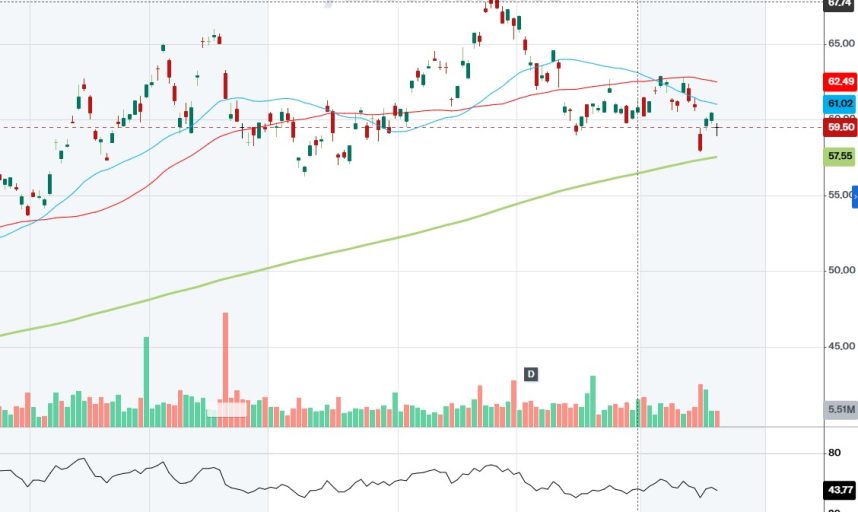
BHP moving averages. Green=200day, red=50, blue=30
The September quarter update was mixed, and whilst the initial move today is lower, the stage is well set for a real test of momentum. Things could get interesting in the days and weeks ahead, as the fundamental updates work through the stock, and the technical picture shifts.
Bull Case:
- Copper prices ~50% higher YoY, cushioning earnings against lower production volumes.
- WAIO delivered record mine and port throughput, reinforcing low-cost iron ore strength.
- Jansen potash project 87% complete, diversifying BHP into high-growth crop nutrients.
- Escondida New Concentrator approval signals multi-decade copper growth conviction.
- FY27 copper guidance unchanged, suggesting management confidence in recovery trajectory.
Bear Case:
- Copper production fell 19% YoY; requires ~441kt quarterly run-rate to meet guidance.
- Two worker fatalities introduce regulatory scrutiny and near-term operational disruptions.
- Escondida grade decline and weather risks could extend production weakness into Q2.
- Stock trading below key 30-day and 50-day SMAs, signalling weak short-term momentum.
- Chinese steel demand softness poses ongoing headwind to BHP’s core iron ore earnings.




