




Commonwealth Bank of Australia shares (ASX: CBA) posted their strongest single-session gain in weeks, adding 3.29% as a softer-than-expected September labour market report sharply reduced the probability of a near-term RBA rate hike. The move, which lifted the CBA share price 4.6% on the week underscored the stock’s appeal as a defensive anchor in periods of volatility.
CBA closed at A$156.15 on Thursday, reclaiming its 30-day SMA at A$152.80 with conviction and mounting an intraday test of the 50-day at A$156.85. The stock fell just short of a clean close above that level, setting the stage for the final session of the week.
The broader market has been rotating, with high-beta sectors bearing the brunt of the selling. The Information Technology sector (XIJ) fell 3.41% and Materials (XMJ) dropped 3.95%, as global growth concerns and stretched valuations prompted a broad exit from cyclical and commodity-linked names. Capital that exited those sectors found its way into large-cap financials, with the ASX Financials sector advancing approximately 2.2% on the day.
Data Driving Markets
Bank of Queensland shares added 5.86% having reported on the day, with FY26 cash profit excluding one-offs down 7%, slightly below estimates on higher bad debts, but second-half profit returned to growth as margins widened.
Thursday’s move also took place against the backdrop of Australia’s September labour force survey, which missed consensus estimates across nearly every headline measure. The economy shed 39,300 jobs during the month, a sharp reversal from August’s 39,500 gain and well below market expectations for a 20,000 increase.
Top Australian Brokers
- Pepperstone - Top Australian broker - Read our review
- eToro - Invest in ASX and international shares - Read our review
The miss was driven almost entirely by a collapse in part-time employment, which fell 73,700 after rising 45,800 in the prior month. Full-time employment provided a partial offset, rising 34,400 after a 6,300 decline in August, while hours worked also ticked higher, a nuance that tempered some of the headline alarm.
The unemployment rate rose 0.1 percentage points to 4.7%, edging above the 4.6% forecast, while the participation rate slipped 0.2 percentage points to 66.8%, against expectations of a steady 67.0% reading. The employment-to-population ratio fell 0.3 percentage points to 63.6%. Perhaps most notably, the underutilisation rate climbed 0.2 percentage points to 11.0%, its highest reading since November 2021. Underemployment alone rose 0.1 percentage points to 6.3%.
Regionally, New South Wales bore the sharpest deterioration, with employment contracting 0.8% and the state unemployment rate jumping 0.4 percentage points to 4.7%. Western Australia bucked the national trend, with employment rising 1.3% over the same period.
The Australian 3-year government bond yield fell 11 basis points to 4.81%, its lowest level since September 9, as traders repriced the probability of a November RBA rate hike sharply lower, pricing implied roughly 17% odds of a hike, down from 32% prior to the data release.
What It All Means
For CBA specifically, the rate outlook shift carries meaningful implications. As Australia’s largest home lender by mortgage book, CBA’s earnings profile is acutely sensitive to the trajectory of household debt serviceability. A pause in the RBA’s tightening cycle reduces the near-term risk of mortgage stress escalating into material credit impairment charges, which had been a growing concern among analysts monitoring arrears trends across the major banks. Lower expected rates also support asset valuations on the bank’s balance sheet and reduce the pressure on net interest margins from deposit repricing dynamics that tend to intensify in a rising-rate environment.
At the same time, the labour data carries a less flattering read-through for the medium-term loan growth outlook. A softening jobs market, declining participation, and rising underemployment collectively point to slower household income growth, which constrains the organic expansion of CBA’s mortgage and consumer lending portfolios. Credit quality may hold in the near term, but loan origination volumes could face headwinds if labour market conditions continue to deteriorate.
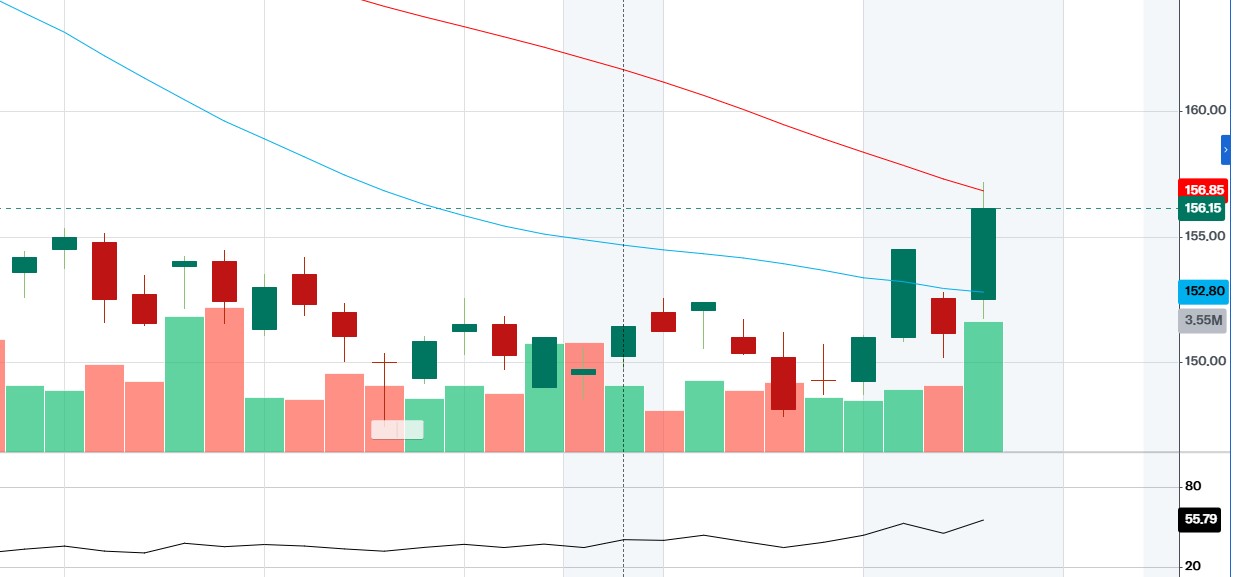
red=50 day SMA, blue=30 day
The gains for CBA will be well received by bulls however they come, but with the 50-day SMA still untested on a closing basis and a valuation multiple that demands near-flawless execution, we would be looking for a strong close ahead of the weekend as a sign that momentum may be finally be turning. You can see on the daily candles above that this is the first test of the 50 day, and just the second close above the 30 day in over a month. With the RSI moving back into neutral territory at 55.79, the tides of selling pressure appear to have eased. But it is the confirmation that follows a move that is more telling.




