



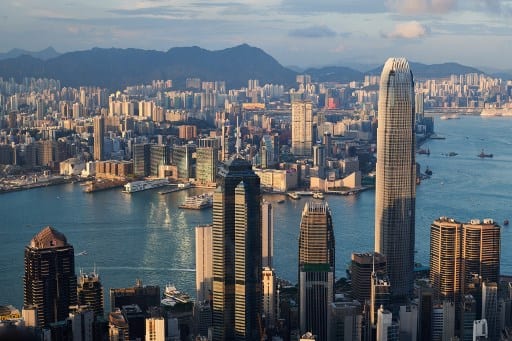
The Hang Seng Index closed 0.98% lower at 25,465.60 ahead of the weekend, bringing year-to-date losses to 3.31% as geopolitical tensions and deteriorating technical conditions weigh on sentiment across Asia’s financial hub.
Friday’s decline marks another session of pressure for Hong Kong’s benchmark index, which has struggled to regain momentum following a sharp pullback from late-January highs. The move lower comes as markets digest the fallout from the US-Iran conflict that erupted on 28 February 2026, triggering a broad risk-off wave across global equities and sending energy prices climbing.
The Hang Seng’s Friday close represents a continuation of weakness that has seen the index pull back 4.37% in two weeks, and into negative territory YTD, significantly underperforming mainland Chinese indices (SSE Index down 1.6%) during the same period.
Technically, the index has now decisively broken below the psychologically important 26,000 level, a threshold that had provided support during earlier 2026 volatility. RHB Research maintained its negative trading bias on 12 March 2026, recommending traders hold short positions initiated at 26,367 on 26 February as futures slipped below 26,000 and failed to extend any meaningful rebound.
Geopolitical Shock Dominates Sentiment
The dominant macro narrative shaping Hong Kong equities in recent weeks centres on the US-Iran war that commenced in late February. The conflict has triggered a sharp repricing in global interest rate expectations, with markets now anticipating approximately 40 basis points of Federal Reserve cuts for 2026, down from roughly 57 basis points just a week earlier, according to HLB Bank’s global markets analysis dated 6 March 2026.
Top Australian Brokers
- Pepperstone - Top Australian broker - Read our review
- eToro - Invest in ASX and international shares - Read our review
Higher global yields and elevated energy prices have created a particularly challenging environment for the Hang Seng, which functions as a high-beta proxy for global risk appetite. Foreign capital flows, already cautious on China and Hong Kong exposure, have accelerated outward as the war introduces fresh uncertainty into growth forecasts and corporate earnings outlooks.
The technology-heavy composition of the Hang Seng has amplified the index’s sensitivity to these macro crosscurrents. Wall Street’s ongoing reassessment of artificial intelligence valuations and concerns about stretched multiples in the tech sector have spilled over into Hong Kong-listed internet and technology names, which carry lower starting valuations but remain exposed to US export control risks and regulatory uncertainty.
Financial stocks have also contributed to the weakness. On a recent session when the index dropped more than 2% below 26,000, banks led the decline with losses exceeding 2%. While higher global yields theoretically benefit net interest margins, the current environment has seen financials trade more as risk proxies than beneficiaries of rate dynamics, particularly as concerns about capital flows and asset quality intensify during periods of geopolitical stress.
A Shift From Last Year’s Gains
The 3.31% year-to-date decline takes on different meaning when viewed against 2025’s performance backdrop. The Hang Seng delivered added 28% through calendar 2025, ending the year with a significant outperformance on both U.S, and Australian markets.
This context suggests the current pullback represents a partial retracement of last year’s rally rather than the onset of a deep bear market. Markets appear to be digesting 2025’s strong returns while navigating a more complex 2026 environment characterised by higher yields, persistent geopolitical risk, and questions about the sustainability of China’s economic recovery.
The index composition changes announced by Hang Seng Indexes Company, effective after the market close on 6 March 2026, have added another layer of complexity to near-term price action. The scheduled review results trigger mechanical rebalancing flows as passive funds and index-tracking products adjust their holdings, potentially distorting short-term moves around constituent additions, deletions, and weight changes.
China Macro Backdrop Remains Mixed
Underlying the Hang Seng’s struggles is an ongoing debate about mainland China’s economic trajectory and policy response. While Beijing has implemented various support measures, markets continue to look for more forceful fiscal and credit stimulus to underpin growth momentum. Lingering concerns about the property sector and the pace of consumption recovery act as a persistent drag on sustained bullish sentiment, even during periods when external risk conditions improve.
The gradual shift in index composition toward “new economy” sectors—technology, consumption, and growth-oriented businesses—represents a medium-term structural positive for the Hang Seng’s appeal to global allocators. However, that thematic evolution provides little near-term relief when macro headwinds are intensifying and risk appetite is contracting.
Outlook
The immediate outlook for the Hang Seng hinges on two key variables: the trajectory of the US-Iran conflict and the index’s ability to defend the 24,700-24,800 support zone. A breakdown below that technical floor would likely trigger fresh selling pressure and potentially test levels not seen since the depths of previous correction phases. Conversely, any signs of war de-escalation or stabilisation in global yields could provide the catalyst for a relief rally back toward 26,000.
Analysts remain divided on the medium-term picture. Bears point to the combination of elevated geopolitical risk, tighter global financial conditions, and China’s modest growth outlook as reasons to maintain defensive positioning. The explicit recommendation from technical desks to hold short positions below 26,000 reflects this cautious stance.
Bulls, while clearly in the minority in current market conditions, argue that the Hang Seng’s valuation discount relative to US and European indices creates asymmetric opportunity for contrarian allocators. The strong 2025 base, ongoing index modernisation, and potential for Chinese policy support represent ingredients for a recovery scenario, though one that requires patience and a meaningful improvement in the external environment.
Bull Case:
- Strong 2025 base of 28% gains suggests pullback is retracement, not new bear market
- Valuation discount versus US and European indices creates contrarian entry opportunity
- Index recomposition toward growth sectors enhances medium-term appeal to global allocators
- Critical support zone at 24,700-24,800 has held, potentially forming basing pattern
- Any war de-escalation or yield stabilisation could trigger sharp relief rally
Bear Case:
- US-Iran war elevates geopolitical risk premium and sustains global risk-off sentiment
- Technical breakdown below 26,000 with sell-the-rally bias from strategists favours further weakness
- Higher global yields and reduced Fed cut expectations tighten financial conditions
- Hong Kong significantly underperforming mainland Chinese indices signals capital flow concerns
- China macro outlook remains modest with insufficient policy stimulus to drive sustained recovery
Friday’s 0.98% decline and the 3.31% year-to-date loss encapsulate a market caught between the gravitational pull of near-term risk aversion and the longer-term structural case for exposure to Asia’s growth story. For now, sellers remain in control, technical momentum favours further weakness, and the burden of proof rests squarely on bulls to demonstrate that support will hold and catalysts for reversal are materialising.




