



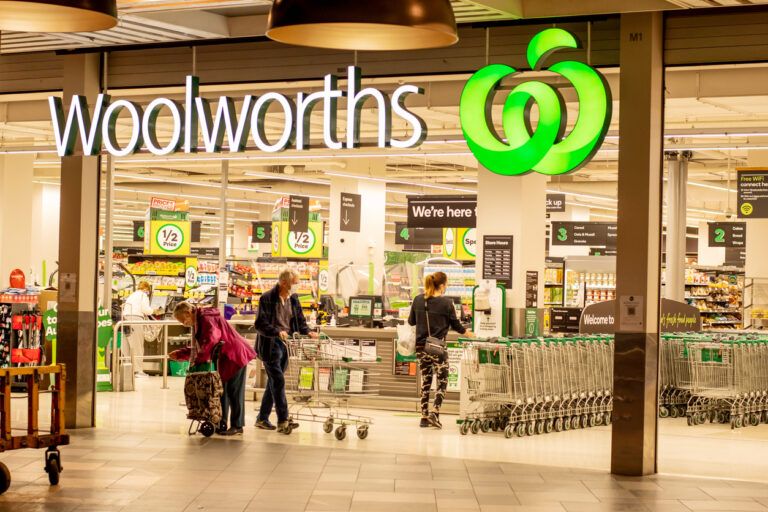
Woolworths Group shares (ASX: WOW) are in the midst of their worst single-day decline in months today, dropping 7.5% to A$34.50 despite reporting solid third-quarter sales growth, as management flagged margin pressure from rising fuel costs and increased investment in customer value.
The Woolworths share price sits A$2.80 lower at A$34.50, wiping more than A$2 billion from market cap, and making WOW one of the biggest laggards on the ASX 200, which itself looks set to take an eight consecutive lower close on concerns about fuel costs and potential interest rate increases. Despite the sharp pullback, Woolworths shares remain 17.8% higher year-to-date, reflecting the stock’s strong performance earlier in the financial year following a record one-day gain after its February half-year results.
Strong Top-Line Performance Masks Margin Concerns
Woolworths reported group sales of A$18.1 billion for the 13 weeks ended 5 April 2026, representing growth of 4.5% on the prior corresponding period. The headline figures demonstrated the company’s continued ability to capture market share and customer wallet despite acute cost-of-living pressures across Australian households.
Top Australian Brokers
- Pepperstone - Top Australian broker - Read our review
- eToro - Invest in ASX and international shares - Read our review
Australian Food, the group’s core division, delivered sales of A$13.8 billion, up 5.9% year-on-year. More impressively, Woolworths Food Retail sales excluding tobacco grew 7.3%, indicating genuine volume and mix strength rather than simply price inflation flowing through. The company’s focus on fresh products, digital tools, and targeted promotions appeared to resonate with customers seeking value without sacrificing quality.
Group eCommerce sales surged 20.2% to A$2.7 billion, now representing 16.6% of Australian Food sales and underscoring the structural shift toward online grocery shopping. Digital platform traffic increased 10.5%, while the Everyday Rewards loyalty programme reached a record 10.7 million active members. The Group Net Promoter Score rose three points to 47 compared with March 2025, suggesting customer satisfaction metrics remain healthy despite public scrutiny around supermarket pricing practices.
New Zealand Food sales grew a more modest 1.4% in New Zealand dollar terms, reflecting what management described as a challenging retail environment and ongoing operational transformation that is taking longer than anticipated to deliver results. The W Living division, encompassing BIG W and Petstock, recorded sales growth of 4.8%, with the Petstock pet specialty business particularly strong at 15.9% growth.
Guidance Revision Triggers Sell-Off
The market’s negative reaction centred not on the quarterly sales performance but on subtle yet significant changes to the company’s earnings outlook for the full 2026 financial year. Management indicated that Australian Food EBIT growth would remain in the mid-to-high single-digit range but would no longer track toward the upper end of that range, citing higher fuel costs and additional investment in value and support for customers facing inflation.
For New Zealand Food, Woolworths guided that the retail environment would remain tough, with transformation progress slower than hoped. The company now expects second-half EBIT to be slightly below the prior year, although full-year FY26 EBIT should still exceed FY25 levels. This represented a downgrade from earlier expectations that the New Zealand turnaround would accelerate through the second half.
Woolworths Group CEO Amanda Bardwell directly addressed the emerging headwinds in the company’s outlook statement: “Looking ahead, the conflict in the Middle East is creating greater uncertainty for our customers, suppliers and team at a time when cost-of-living pressures are already acute. While the impact on the Group to date has been limited, higher fuel costs and secondary effects are likely to have an increasing inflationary impact as we move through the calendar year.”
The explicit reference to geopolitical risks and their potential to drive secondary inflation through supply chains signalled to markets that the operating environment may deteriorate further before improving. With fuel representing a significant cost component across logistics, store operations, and customer purchasing power, the warning carried particular weight.
Regulatory and Competitive Pressures Mount
Beyond the immediate financial metrics, Woolworths continues to navigate heightened regulatory scrutiny and competitive intensity across both its Australian and New Zealand operations. Recent months have seen increased political and media attention on alleged pricing practices by major supermarket chains, with accusations of misleading promotional tactics and inadequate price competition.
Social media commentary and community forums have featured calls for consumer boycotts, though the company’s rising Net Promoter Score and record loyalty membership suggest these campaigns have not yet materially damaged customer behaviour. Nonetheless, the reputational risk and potential for formal regulatory intervention remain overhangs that could constrain the company’s pricing flexibility and margin management in future periods.
In New Zealand, the competitive landscape has intensified alongside regulatory pressure around market concentration and supermarket pricing power. Woolworths’ operational changes, including store format adjustments and range rationalisation, are designed to improve profitability but require time to flow through to financial results.
The Australian market remains highly competitive, with Coles matching Woolworths’ promotional activity and independent operators and discount chains like Aldi continuing to gain traction among price-conscious shoppers. Customer trading down to private label products has accelerated, which benefits Woolworths’ own-brand margins but puts pressure on supplier relationships and overall basket values.
Digital and Loyalty Franchise Remains Differentiator
Despite the near-term margin pressures, Woolworths’ continued investment in digital infrastructure, data analytics, and customer engagement platforms is building a structural competitive advantage that should support market share and profitability over the longer term. The 20% growth in eCommerce sales significantly outpaces physical store growth and positions the company to capture the ongoing channel shift toward online grocery shopping.
The Everyday Rewards programme, with its 10.7 million active members, provides Woolworths with granular customer purchase data that enables highly targeted promotional activity and personalised offers. This data asset allows the company to invest in price and value more efficiently than competitors with less sophisticated loyalty and analytics capabilities, potentially protecting margins even as promotional intensity increases.
Digital platform traffic growth of 10.5% suggests customers are increasingly engaging with Woolworths through mobile apps and online channels, creating opportunities for additional revenue streams through advertising, third-party partnerships, and premium delivery services. These emerging revenue sources, while currently small, represent potential margin upside as the digital ecosystem matures.
Outlook
Looking ahead to the full-year results scheduled for August, markets will focus on three key areas: the trajectory of Australian Food margins in the face of fuel and wage cost inflation, evidence of operational progress and profitability improvement in New Zealand, and any updates on regulatory developments affecting the supermarket sector.
The company’s ability to balance investment in customer value with protection of shareholder returns will be critical. Woolworths has historically demonstrated strong cost discipline and operational efficiency, but the current environment of elevated input costs, intense competition, and public scrutiny of pricing practices represents a particularly challenging combination.
Macroeconomic conditions will play a significant role in determining the stock’s near-term performance. If Australian inflation continues to accelerate, forcing the Reserve Bank of Australia to raise interest rates further, consumer spending power will deteriorate and valuation multiples for defensive stocks may compress further. Conversely, if inflation peaks and begins to moderate, allowing real incomes to stabilise, Woolworths’ market-leading position and digital capabilities should support earnings growth and multiple expansion.
Bull Case:
- Australian Food sales growth of 5.9% demonstrates market share gains in tough environment
- eCommerce surging 20.2% with digital now 16.6% of Food sales, structural tailwind intact
- Record 10.7 million Everyday Rewards members provides unmatched customer data and targeting capability
- Net Promoter Score rising despite pricing scrutiny suggests brand strength and customer loyalty holding
- Defensive earnings profile and scale advantages position company to manage inflation better than peers
- 6.9% sell-off may create attractive entry point for long-term holders after valuation reset
Bear Case:
- Australian Food EBIT guidance downgraded from upper end of range, margin pressure intensifying
- New Zealand second-half EBIT expected below prior year, turnaround taking longer than anticipated
- Fuel cost inflation and geopolitical risks creating increasing uncertainty through calendar year
- Regulatory scrutiny and fake discount allegations raise intervention risk and constrain pricing flexibility
- Re-accelerating CPI and potential RBA tightening weigh on consumer wallets and defensive stock multiples
- Valuation still elevated on conservative intrinsic value models despite pullback, limited upside near-term
Today’s pullback reflects markets recalibrating expectations for Woolworths’ near-term profitability trajectory, with the subtle downgrade to Australian Food EBIT guidance and ongoing New Zealand challenges outweighing solid sales momentum and strong customer engagement metrics.
The company’s explicit warning about fuel cost inflation and geopolitical uncertainty added to concerns that the operating environment may deteriorate before improving, while regulatory scrutiny and competitive intensity continue to constrain pricing flexibility.




