



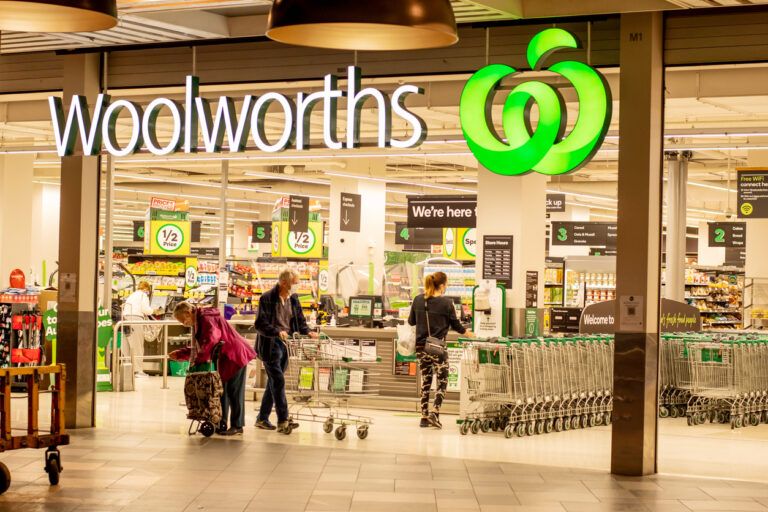
Woolworths Group shares (ASX: WOW) have put up a mighty 34% year-to-date rally to sit at A$39.44, prompting Goldman Sachs to downgrade the supermarket giant to Neutral from Buy as the stock trades above its A$37 price target, marking a dramatic shift in broker sentiment after what has been a huge year of outperformance.
The Woolworths share price sits at A$39.44 heading into today’s open, representing a 34% gain in calendar 2026 and vastly outpacing the ASX 200′s modest 1.9% advance over the same period. The stock has climbed from a A$29 handle at the start of the year, adding just over A$10 per share in value and delivering one of the strongest performances among large-cap names.
The rally has pushed Woolworths’ market capitalisation above A$48 billion, cementing its position as Australia’s largest pure-play supermarket operator by market value.
Goldman Sachs Downgrade
Goldman Sachs analyst Peter Marks downgraded Woolworths to Neutral from Buy while maintaining an unchanged price target of A$37, explicitly citing valuation as the primary driver. With the stock now trading roughly 6.5% above Goldman’s target, the firm’s stance implies limited upside and potential downside risk from current levels over the next twelve months.
Top Australian Brokers
- Pepperstone - Top Australian broker - Read our review
- eToro - Invest in ASX and international shares - Read our review
The Goldman move follows a pattern of broker reassessments throughout 2026.
Citi recently downgraded Woolworths to Sell from Neutral in mid-July, paradoxically raising its price target from A$34 to A$36 but arguing the stock has run well ahead of even improved fundamental expectations.
The clustering of broker price targets in the mid-to-high A$30s range, combined with multiple rating downgrades despite stable or improving earnings forecasts, underscores a market grappling with a high-quality business trading at an increasingly demanding valuation.
Strong Performance Behind The Rally
Woolworths’ share price surge has been underpinned by solid operational execution and better-than-expected earnings. The company’s February 2026 interim result triggered what FNArena described as the largest single-day share price rise in Woolworths’ history, with the result categorised as a clear earnings beat against consensus expectations.
Australian Food EBIT growth has remained in the mid-to-high single digits, demonstrating resilient demand in the company’s core grocery business despite ongoing cost-of-living pressures facing consumers. Management has maintained investment-grade balance sheet metrics and continued to return capital to shareholders through dividends, reinforcing the defensive characteristics that have attracted investors during a volatile market environment.
However, more recent guidance updates have introduced notes of caution. In late April, Woolworths indicated that Australian Food EBIT growth would no longer track at the upper end of its mid-to-high single-digit range, as the company absorbs supply chain cost pressures. New Zealand Food EBIT was flagged to be modestly down year-on-year in the second half of fiscal 2026 in New Zealand dollar terms, highlighting regional headwinds.
Regulatory and Political Headwinds
Beyond valuation concerns, Woolworths continues to navigate regulatory scrutiny and public criticism over grocery pricing. Throughout 2025 and 2026, the company has faced Australian Competition and Consumer Commission investigations and political pressure over alleged price gouging, with media commentary highlighting high supermarket margins amid consumer cost-of-living pain.
Despite the noise, regulatory risks have not yet materialised into material penalties or legislative constraints severe enough to derail the earnings story. Management’s strategic decision to absorb some cost pressures rather than aggressively pass through price increases has been interpreted by some brokers as protecting long-term market share and customer trust, even at the expense of near-term margin maximisation.
The balance sheet remains robust, with investment-grade credit metrics providing flexibility for continued capital expenditure and shareholder distributions. This financial strength underpins the bull case that Woolworths can weather regulatory challenges and maintain its competitive position.
What Comes Next
The broker community’s shift from predominantly Buy ratings earlier in 2026 to a mix of Neutral, Hold, and Sell ratings reflects a fundamental reassessment of risk-reward. The consensus view has moved, with the Goldman Sachs downgrade serving as one of the most visible signals of that transition.
For bulls, the investment case rests on continued operational delivery, defensive earnings resilience, and the possibility that macro uncertainty keeps a bid under high-quality staples regardless of valuation. Any further earnings beats or evidence of sustainable margin expansion could support the current multiple or even drive modest additional gains.
Bears, however, point to limited mathematical upside with most price targets sitting 5-10% below the current share price, and meaningful downside risk if earnings guidance softens, regulatory action intensifies, or markets rotate away from expensive defensives as risk appetite improves. The gap between share price and broker targets suggests the market may be pricing in a level of perfection that leaves little room for disappointment.
Bull Case:
- Defensive earnings model provides visibility in uncertain macro environment
- Repeated operational beats demonstrate pricing power and cost discipline
- Investment-grade balance sheet supports sustainable dividends and growth investment
- Market share stability versus Coles underpins competitive moat
- Strategic cost absorption protects long-term franchise value and customer loyalty
Bear Case:
- Trading 6-7% above consensus broker price targets implies downside risk
- Forward P/E in high-20s sits at top of historical range
- Guidance softening on margins as cost pressures intensify
- Regulatory and political scrutiny threatens future pricing power
- Rotation risk if markets shift away from expensive defensive stocks




