



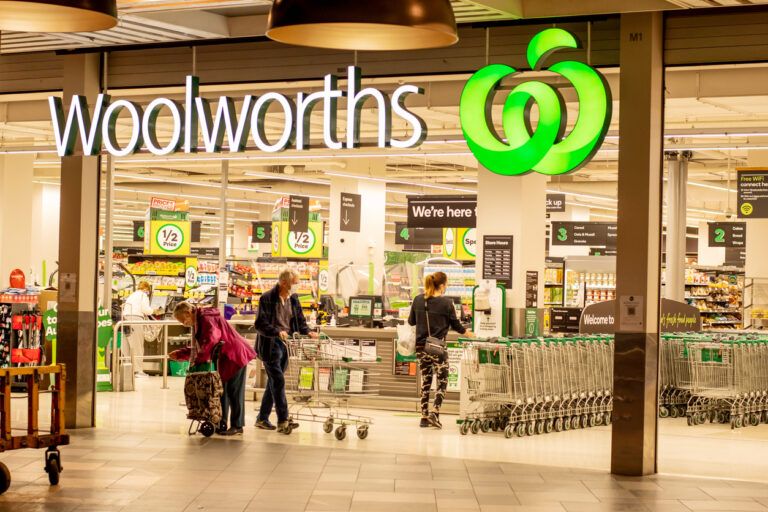
Woolworths shares (ASX: WOW) enjoyed a nice bounce today, rising 4.09% to A$34.33, after JPMorgan upgraded the supermarket giant to overweight and set a price target implying further gains ahead.
The Woolworths share price bounced off technical support in the A$32–33 zone, a level that has held through recent volatility. JPMorgan analyst Bryan Raymond lifted his rating from neutral to overweight, establishing a A$37.00 price target that suggests approximately 7% upside from current levels. The move marks a notable shift in sentiment for a stock that has endured significant pressure in recent weeks, with the shares having tumbled as much as 9% intraday following the company’s third-quarter trading update in late April.
That sharp selloff came despite Woolworths posting solid sales numbers, underscoring how fixated markets had become on margin trajectory rather than top-line resilience. The stock’s recovery from the A$32–33 support band suggests some investors are now prepared to look past near-term cost headwinds and focus on the franchise’s underlying strength.
Why Were Woolworths Shares Down?
Woolworths reported group sales of A$18.1 billion for the 13 weeks ending 5 April 2026, representing growth of 4.5% on the prior corresponding period. The result came in ahead of consensus expectations of approximately A$17.98 billion. Australian Food sales, the company’s core division, rose 5.9% to A$13.8 billion, with Woolworths Food Retail growing 7.3% when tobacco sales are excluded. The company’s eCommerce channel continued its strong expansion, with sales surging 23.8% during the quarter.
Top Australian Brokers
- Pepperstone - Top Australian broker - Read our review
- eToro - Invest in ASX and international shares - Read our review
The sales acceleration was particularly notable given it followed a more modest 3.4% group sales increase in the first half of fiscal 2026. Item growth remained robust, and management commentary pointed to improving customer perceptions, with Net Promoter Scores trending higher as the company emphasised value and product availability.
Yet markets reacted harshly to the update, sending the shares down between 7% and 9% on the day of release. The focus quickly shifted from sales momentum to the cost base. Management flagged mounting pressure from fuel and logistics expenses, with direct fuel exposure expected to weigh on fourth-quarter EBIT margins. The company also announced a three-month price freeze on 300 household staples effective 1 May 2026, a customer-friendly initiative that nonetheless signals willingness to accept near-term margin dilution in exchange for volume and brand loyalty.
Supply-chain disruptions linked to Middle East geopolitical tensions and elevated energy costs were cited as key drivers of input cost inflation. Management also noted emerging signs of consumer caution late in the quarter, suggesting households may be pulling back on discretionary spending or trading down within their grocery baskets.
Analyst Perspective
JPMorgan’s upgrade reflects a view that the market overreacted to the margin pressures outlined in the third-quarter update. The broker’s stance appears predicated on evidence that Woolworths is still gaining or defending market share, with sales growth outpacing broader food retail trends and customer satisfaction metrics improving. The firm has also raised its earnings per share forecasts for fiscal years 2026 through 2028, signalling confidence in a multi-year recovery trajectory.
The call echoes an earlier JPMorgan overweight recommendation that highlighted narrowing like-for-like sales gaps versus rival Coles and structural improvements in the business mix. However, the A$37 price target implies relatively modest upside, suggesting even bulls view Woolworths as a quality defensive play rather than a deeply undervalued opportunity.
Other data supports the case for cautious optimism. First-half fiscal 2026 results, released in mid-April, showed earnings before interest and tax rising 14.4% to A$1.66 billion, with EBIT margin expanding 43 basis points. Net profit after tax before significant items climbed 16.4% to A$859 million, demonstrating the company’s ability to grow profitability even in a challenging operating environment.
Yet that margin expansion came before the full brunt of fuel cost increases and the price-freeze initiative hit the income statement. Management’s cautious tone on the outlook, combined with explicit warnings about fourth-quarter cost impacts, has left some market participants unconvinced that the worst is behind the business.
What Lay Ahead
From a technical standpoint, the repeated bounce from the A$32–33 support zone provides a clear reference point for risk management. The level has held through multiple tests in recent weeks, having previously acted as resistance back in February. Positioning dynamics may also be at play. Woolworths is widely held as a defensive, dividend-paying staple, and the sharp post-results selloff likely triggered some forced selling or profit-taking among momentum-oriented holders. The subsequent rebound could reflect a combination of short covering, value buyers stepping in at support, and a reassessment of the risk-reward balance following the initial capitulation.
Markets will likely remain focused on the fourth-quarter update and full-year fiscal 2026 results for clarity on what comes next. For now, JPMorgan’s upgrade and the technical bounce suggest a near-term shift in sentiment to cautious optimism. Whether that proves durable will depend on Woolworths’ ability to navigate a complex operating environment where sales strength must be balanced against cost discipline, competitive intensity, and political scrutiny.
Bull Case:
- Strong sales momentum with Australian Food up 5.9% and eCommerce surging 23.8%
- JPMorgan upgrade to overweight signals institutional confidence in earnings recovery trajectory
- H1 FY26 margin expansion of 43 bps demonstrates ability to grow profitability
- Improving customer metrics and Net Promoter Scores support long-term market share defence
- Technical support at A$32–33 has held, providing clear downside floor for positioning
Bear Case:
- Rising fuel and logistics costs expected to compress Q4 EBIT margins significantly
- Three-month price freeze on 300 staples will weigh on near-term profitability
- ACCC regulatory action and political scrutiny constrain pricing power and introduce uncertainty
- A$37 price target implies only modest 7% upside, insufficient for margin risks
- Consumer caution emerging late in Q3 threatens basket sizes and trading patterns




