
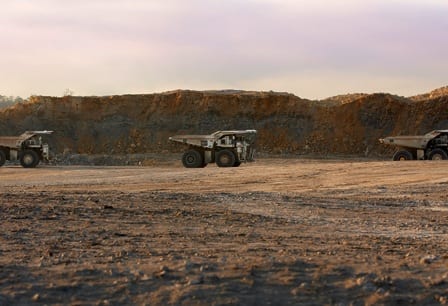
Whitehaven Coal shares (ASX: WHC) rounded out last week at A$7.91, up 3.4% on the day, as markets responded favourably to the company’s September quarter (Q1 FY27) production report. The operational update highlighted a meaningful production beat and strong realised prices, sending shares back into positive territory on the year, up 1.28% YTD.
What Was In The Whitehaven Coal Update?
Whitehaven’s managed run-of-mine (ROM) coal output for the September quarter reached 11.0 million tonnes (Mt), representing a 22% increase year-on-year and a 3% lift quarter-on-quarter. The result comfortably exceeded Visible Alpha consensus estimates of approximately 9.5 Mt, marking one of the company’s strongest quarterly production outcomes since completing its transformative acquisition of the Blackwater and Daunia metallurgical coal mines from BHP.
The Queensland operations contributed 5.5 Mt of managed ROM coal, up 17% year-on-year, with the newly integrated Blackwater and Daunia assets performing ahead of integration expectations. The New South Wales operations matched Queensland’s output at 5.5 Mt, a 27% year-on-year improvement, underpinned by an uninterrupted run at the Narrabri underground mine. Narrabri’s annualised output for the quarter represented its best performance in nearly four years, a notable operational milestone for the NSW thermal coal flagship.
Pricing and Cost Discipline
The pricing environment remained constructive across both coal segments. The group’s average achieved price rose to A$226 per tonne, a 20% improvement compared to the prior corresponding period’s A$188 per tonne. Queensland metallurgical coal realisations averaged A$257 per tonne, while NSW thermal coal averaged A$198 per tonne, equivalent to 103% of the globalCOAL Newcastle (gC NEWC) benchmark, a premium outcome that reflects the quality of Whitehaven’s thermal product.
Cost management was equally encouraging, as unit costs for the quarter tracked at the lower end of the company’s full-year guidance range of A$132 to A$147 per tonne, a creditable outcome given that diesel prices averaged A$1.38 per litre during the period, meaningfully above the company’s full-year planning assumption of A$1.16 per litre. The ability to absorb elevated fuel costs while maintaining cost discipline at the guidance floor speaks to the operational leverage embedded in the expanded asset base.
Top Australian Brokers
- Pepperstone - Top Australian broker - Read our review
- eToro - Invest in ASX and international shares - Read our review
Inventory Build
Managed coal sales of produced coal fell 5% quarter-on-quarter to 6.0 Mt, as planned and unplanned outages at two key export terminals disrupted shipping schedules. The RG Tanna coal terminal in Queensland experienced approximately 12 outage days, while the Port Waratah Coal Services (PWCS) terminal in New South Wales also faced disruptions. The combined effect was a meaningful shortfall in vessel throughput relative to production, pushing group closing coal stocks up 37% quarter-on-quarter.
The inventory build, while temporary, had a tangible impact on near-term cash conversion. Net debt stood at approximately A$1.4 billion as of 30 September 2026, reflecting both the timing mismatch between production and sales and ongoing capital distributions, including A$14 million in on-market share buybacks completed during the quarter. Management confirmed that port issues have since been resolved and that the accumulated inventory is expected to unwind into stronger cash inflows during the December quarter.
Guidance Reaffirmed
Despite the logistical headwinds, management maintained all full-year targets. Managed ROM production guidance of 38.0 to 41.0 Mt remains intact, as does equity coal sales guidance of 23.9 to 26.0 Mt and unit cost guidance of A$132 to A$147 per tonne. The reaffirmation carries weight given the disruptions encountered, signalling management’s confidence that Q1’s production strength provides sufficient buffer to absorb the sales slippage without compromising annual targets.
Looking further ahead, Whitehaven is approaching the completion of deferred and contingent acquisition payments related to the BHP Queensland transaction. Once these obligations are fully discharged, the company’s free cash flow profile is expected to improve materially, potentially expanding the scope for capital returns to shareholders in FY27 and FY28.
What Lay Ahead?
Whitehaven’s Q1 update positions the company well heading into the second quarter, with the inventory overhang representing a near-term tailwind rather than a structural concern. If coal prices hold at current levels, the December quarter could deliver a meaningful step-up in cash generation as deferred sales volumes clear through the terminals.
That said, elevated diesel prices could erode the cost advantage if fuel markets do not normalise toward the company’s planning assumptions. The net debt position of A$1.4 billion, while manageable given the asset base and earnings profile, leaves limited room for error if coal prices were to soften materially or if further port disruptions recur.
For now, the balance of evidence from Q1 FY27 tilts towards the bulls, with production ahead of expectations, pricing remains strong, and guidance reaffirmed. That said, the technical setup, with the stock just moving above the 30 day SMA, yet continuing to trade below both the 50 day at A$7.96, and 200 day at A$8.23, suggests the longer term trend remains bearish. Plenty to watch heading into the final week of October, with WHC just holding positive on the year.
Bull Case:
- Q1 ROM production of 11.0 Mt beat consensus by 16%, demonstrating strong operational execution.
- Average achieved price of A$226/t, up 20% year-on-year, supports robust near-term earnings.
- Unit costs at guidance lower bound despite elevated diesel, highlighting structural cost efficiency.
Bear Case:
- Port outages cut quarterly sales 5% and lifted inventory 37%, delaying cash conversion.
- Net debt of A$1.4 billion limits financial flexibility if coal prices soften unexpectedly.
- Diesel at A$1.38/L versus A$1.16/L assumption poses ongoing margin risk if sustained.