



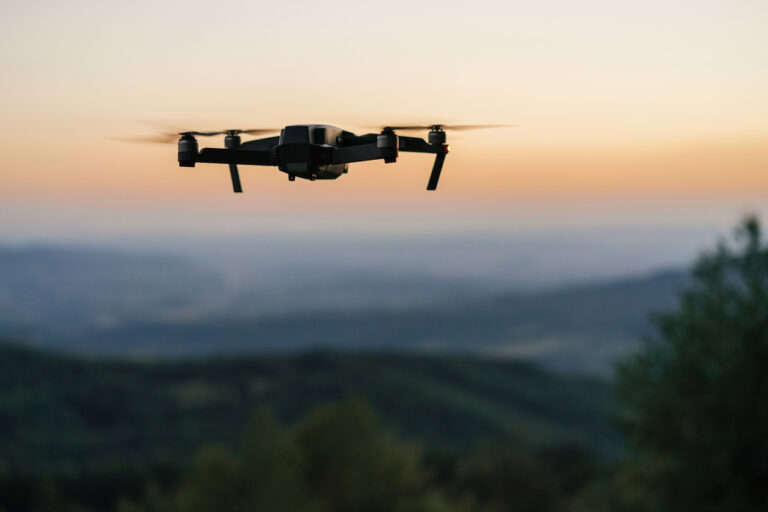
DroneShield shares (ASX: DRO) delivered the strongest performance on the ASX 200 today, surging 10.42% to close at $4.44 as markets responded enthusiastically to a strategic radar partnership that bolsters the company’s sensor-fusion capabilities and European expansion strategy.
The DroneShield share price climbed from yesterday’s test of support at $4.00 to close at $4.44, extending the stock’s month-long rally to 35.37%. The move reflects renewed confidence following a brief retracement in yesterday’s session that tested key technical support levels. With today’s gains, DroneShield has cemented its position as one of the ASX’s standout performers in 2026, driven by a combination of contract momentum and strategic positioning in the rapidly expanding counter-unmanned aircraft systems (C-UAS) market.
The Partnership Behind The DRO Move
DroneShield announced a formal partnership with Dutch radar specialist Robin Radar Systems, a move designed to extend radar interoperability across its product ecosystem and strengthen airspace awareness capabilities for defence and critical infrastructure customers. Robin Radar Systems brings to the table its 360-degree, 3D radar technology, including the IRIS platform, which has been specifically engineered to detect and track small airborne objects such as drones and has undergone independent validation in NATO, European airspace security, and FAA-related evaluation programs.
At the centre of this integration sits DroneShield’s DroneSentry-C2 command-and-control system, which fuses inputs from multiple sensor types; including radio frequency detection, radar, acoustics, and electro-optical/infrared systems, to create a consolidated operational picture. The company stated that this multi-sensor approach “reduces ambiguity and enhances decision confidence” for operators managing complex airspace threats.
Top Australian Brokers
- Pepperstone - Top Australian broker - Read our review
- eToro - Invest in ASX and international shares - Read our review
The partnership represents a strategic evolution for DroneShield, positioning the company less as a point-product hardware vendor and more as a platform integrator capable of incorporating best-of-breed sensors from specialist partners. This approach directly addresses a key requirement in modern defence procurement: multi-sensor, radar-inclusive architectures that provide layered detection and mitigation capabilities.
Markets appear to have recognised the competitive advantage this creates. By formally integrating Robin’s high-fidelity radar systems, DroneShield can now cite proven interoperability in tender responses, potentially improving win rates in European and US contracts where technical risk reduction is a critical evaluation criterion. The move also supports the thesis that software, command-and-control, and analytics will constitute a growing share of revenues, segments that typically command higher margins and more recurring revenue streams than standalone hardware sales.
Building on Expansion
The radar partnership arrives on the heels of DroneShield’s March 11 announcement that it has established counter-UAS manufacturing capacity within the European Union through a contract manufacturing arrangement. The facility will handle full turnkey assembly including printed circuit board assembly, precision machining, cable and wire harness production, plus final assembly and testing of counter-drone systems.
This manufacturing footprint directly addresses a structural barrier in European defence procurement: the increasing emphasis on sovereign capability, local industrial participation, and resilient supply chains. European defence buyers, particularly in the context of the EU’s ReArm Europe and Readiness 2030 initiatives, now routinely weight these factors heavily in tender evaluation criteria. On-shore EU production makes DroneShield’s systems more compliant with those policy objectives and could prove decisive in securing large framework contracts.
The European expansion also adds a second major production line to complement DroneShield’s Australian operations, supporting management’s stated goal of scaling from approximately $500 million to a targeted $2.4 billion in annual production capacity by the end of 2026. Producing closer to end customers cuts logistics costs and lead times while reducing export-control friction, factors that should support gross margin expansion on European contracts.
Management has framed the EU manufacturing investment as a response to sustained demand rather than a speculative bet, pointing to a sequence of major contract wins over the past 18 months that validate the strategic commitment.
The company’s financial performance has reflected this operational momentum. While specific quarterly results for the current period have not yet been released, DroneShield has previously reported revenue growth of 480% year-over-year in certain quarters, supported by a growing contracted backlog and expanding production capacity across its Sydney headquarters and new facilities in Europe and the United States.
Timing and Positioning
The global counter-drone market is experiencing structural growth as military forces and civil authorities grapple with the rapid proliferation of small, inexpensive unmanned aircraft systems. Battlefield experience in Ukraine has demonstrated the effectiveness of consumer-grade drones adapted for military purposes, forcing a wholesale reassessment of short-range air defence requirements across NATO and allied nations.
DroneShield has positioned itself at the intersection of several favourable trends: defence spending increases, artificial intelligence-enabled detection systems, and the policy push for sovereign capability in critical defence technologies. The company’s portfolio now spans handheld jamming devices (DroneGun), portable detection systems (RfPatrol), fixed-site solutions (DroneSentry-X), and the command-and-control layer (DroneSentry-C2) that ties the ecosystem together.
The Robin Radar partnership enhances this platform narrative by adding another high-credibility sensor option without requiring DroneShield to develop proprietary radar capabilities in-house. This asset-light approach to sensor integration allows the company to focus resources on its core differentiator while leveraging specialist partners for underlying detection hardware.
However, the counter-UAS space remains competitive. DroneShield faces competition from other specialist vendors as well as larger defence primes that are increasingly active in the segment. Radar specialists like Robin Radar Systems also work with multiple integrators, meaning partnerships are not necessarily exclusive. As the market matures, competitive pressure on pricing and margins could intensify, particularly as larger players leverage economies of scale.
Despite today’s strong performance, markets will be watching several risk factors closely. After rallying 35% over the past month, a significant portion of the near-term growth story is now reflected in the share price. Any slowdown in the pace of contract announcements, delays in ramping European production, or margin compression from aggressive pricing to win tenders could trigger profit-taking.
Execution risk is also material. Operating manufacturing and research-and-development operations across Australia, Europe, and the United States introduces supply-chain complexity, quality-control challenges, and working-capital requirements that will test management’s operational capabilities as the company scales. The path from hundreds of millions in annual revenue to multi-billion-dollar capacity is littered with potential operational missteps.
Defence spending is inherently subject to political risk. Changes in European or US budget priorities, peace initiatives, or fiscal constraints could slow the rate of new tenders and programme upgrades. While current geopolitical tensions support sustained counter-UAS spending, markets have learned that defence cycles can turn quickly when political winds shift.
Looking Ahead
The immediate catalyst for today’s move is straightforward and easy for markets to understand as it directly upgrades DroneShield’s flagship command-and-control ecosystem with proven, high-fidelity radar technology, strengthening the company’s competitive position in tenders that demand multi-sensor architectures. The partnership sits atop a reinforcing backdrop of European manufacturing expansion and ongoing contract momentum, creating a narrative of compounding strategic advantages.
From here, markets will focus on execution. Can management scale production capacity without quality or delivery issues? Will the European manufacturing footprint translate into a step-change in contract wins during the next tender cycle? And perhaps most critically, can DroneShield maintain its current pace of contract announcements to justify a valuation that now prices in substantial growth expectations?
Bull Case:
- Robin Radar partnership strengthens sensor-fusion moat and improves tender competitiveness significantly
- EU manufacturing solves sovereign-capability hurdle, unlocking multi-billion-dollar European procurement frameworks
- Contract momentum validates product-market fit; repeat orders signal operational embedding not pilots
- Platform narrative supports margin expansion as software and C2 grow revenue share
- Structural counter-UAS tailwinds from Ukraine lessons and drone proliferation remain multi-year
Bear Case:
- Valuation stretched after 35% monthly rally; much of growth story now priced in
- Execution risk scaling to $2.4 billion capacity across three regions with complex supply chains
- Customer concentration in Europe creates earnings volatility if contracts slip or budgets delay
- Competitive intensity rising as defence primes enter market; partnerships not necessarily exclusive
- Political and budget risk could slow tender pace if geopolitical tensions ease unexpectedly




