



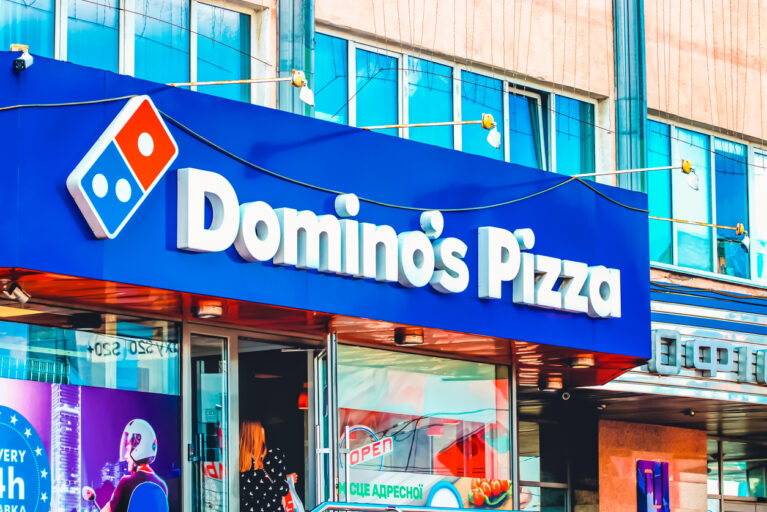
Domino’s Pizza Enterprises shares (ASX: DMP) tumbled sharply despite swinging back to profit, as markets focused on a worrying decline in same-store sales and challenging trading conditions across key markets that overshadowed the company’s strategic turnaround efforts.
The Domino’s Pizza share price closed down 11.08% at A$19.27, extending a recent sell-off that has seen the stock hit near four-month lows. The sharp decline came after the company disclosed a 7.2% drop in same-store sales during the first eight weeks of the second half, compounding concerns about consumer demand and operational momentum. Earlier in February, the stock had already fallen 16% following the release of these trading updates, reflecting heightened market sensitivity to near-term performance metrics despite longer-term strategic progress.
Core Details
The company reported an after-tax profit of A$40.9 million for the six months ending 31 December 2025, a significant reversal from a A$22.2 million loss in the prior corresponding period. Underlying EBIT reached A$101.5 million, representing modest growth of 1.0% year-on-year, signalling that the company’s strategic reset is beginning to gain traction.
Central to the turnaround has been a deliberate shift away from aggressive discounting toward sustainable margin improvement. Average franchise profitability increased 4.5% to A$103,000 per store, demonstrating that the focus on quality over volume is delivering tangible benefits at the franchisee level. This improvement comes despite network sales and same-store sales remaining under pressure across multiple markets.
As the largest Domino’s franchisee outside the United States, Domino’s Pizza Enterprises operates an extensive network spanning Australia, New Zealand, Japan, and parts of Europe. The company’s vertically integrated model, combining company-owned stores, franchise royalties, and supply chain operations, has historically been a competitive advantage, but has not insulated the business from recent headwinds.
Top Australian Brokers
- Pepperstone - Top Australian broker - Read our review
- eToro - Invest in ASX and international shares - Read our review
Regional performance proved mixed during the period. Europe showed pockets of improvement, but trading in Australia and Japan remained challenging. The company attributed the sharp 7.2% decline in same-store sales during early 2025 to severe weather disruptions in Germany and the Netherlands, as well as the delayed timing of Chinese New Year, which affected trading patterns.
In a decisive move to sharpen its operational focus, Domino’s announced the closure of 205 underperforming stores, predominantly in Japan. The closures are expected to generate annualized savings of A$15.5 million once fully implemented, though the company will incur a one-time restructuring charge of A$97 million. Management framed the decision as essential to strengthening the overall network and supporting sustainable long-term growth.
Outlook and Analysis
Markets appear caught between two competing narratives. On one hand, the return to profitability and improving franchise economics suggest the strategic reset is working. On the other, the pronounced weakness in same-store sales and continued regional challenges raise questions about the pace and durability of the recovery.
The decision to close underperforming stores represents a pragmatic acknowledgment that network quality matters more than sheer store count. However, the A$97 million restructuring cost will weigh on near-term earnings, and the company must demonstrate that the remaining network can deliver consistent same-store sales growth to justify the strategy.
Weather disruptions and calendar timing effects may have exaggerated the weakness in early 2025 trading, but underlying consumer demand in key markets remains soft. Rising cost pressures and competitive intensity in the quick-service restaurant sector continue to challenge margins, even as management pulls back on discounting.
The company’s vertically integrated supply chain provides some insulation from external cost shocks, but also means the business is exposed to operational inefficiencies if store-level volumes remain subdued. The success of the turnaround will ultimately depend on whether improved franchise profitability can be sustained while same-store sales stabilize and eventually return to growth.
Bull Case:
- Return to profitability demonstrates turnaround strategy is gaining traction
- Franchise profitability up 4.5% shows sustainable margin improvement taking hold
- Store closures will generate A$15.5 million annual savings and strengthen network
- Reduced discounting positions company for healthier long-term growth trajectory
- Vertically integrated model provides competitive advantages and cost control
Bear Case:
- Same-store sales down 7.2% signals weak consumer demand persists
- Adverse weather impact suggests operational vulnerability to external disruptions
- A$97 million restructuring charge will pressure near-term earnings significantly
- Mixed regional performance indicates recovery remains uneven and fragile
- Share price near four-month lows reflects eroded market confidence
Markets will be watching closely for signs that the second-half trading weakness was indeed temporary, or whether deeper structural challenges persist. The strategic reset has bought time and stabilized profitability, but the path from here requires consistent execution and a more supportive demand environment across the company’s diverse geographic footprint.




