



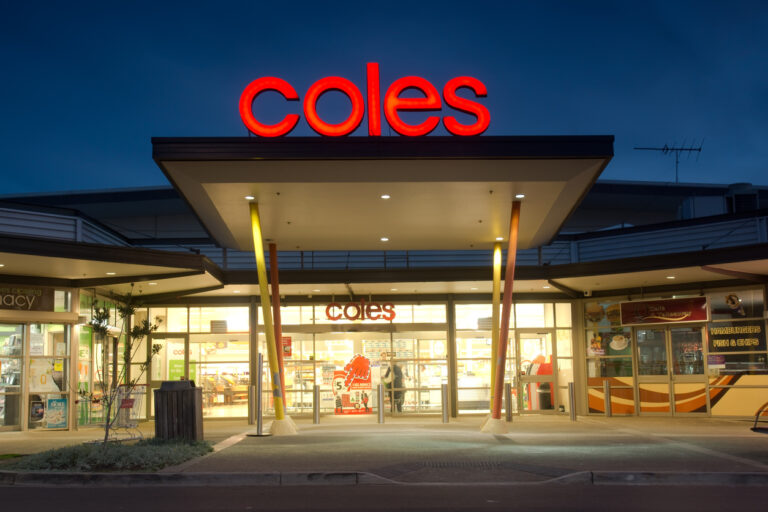
Coles shares (COL: ASX) have rallied sharply this week, climbing 8.51% as markets pivot back toward defensive, non-discretionary stocks amid lingering economic uncertainty and rate volatility.
The Coles share price has built substantial momentum over the past five trading days, pushing the stock’s Relative Strength Index to 77.68, firmly into overbought territory by technical measures. The rally represents a significant reversal from earlier weakness that had dragged the stock lower on regulatory concerns and cost-of-living scrutiny throughout late 2025 and early 2026.
The move higher comes despite an intensifying regulatory backdrop. In May 2026, a Federal Court judge found Coles had misled shoppers by increasing prices on hundreds of products before advertising them as “discounts” under its “Down Down” promotional program. The court held that the higher reference prices had not been in place long enough to justify the discount messaging, a finding that followed years of Australian Competition and Consumer Commission investigation into supermarket pricing practices.
Separately, the ACCC issued infringement notices to Coles over restrictive milk supply terms and unclear pricing, resulting in a modest A$39,600 penalty. While financially immaterial, the action added to a pattern of regulatory enforcement that has kept Coles and rival Woolworths in the political and media spotlight.
Fundamentals Holding Up
Despite the regulatory noise, Coles’ underlying operational performance has remained resilient. The company reported first-half fiscal 2026 results in February showing group sales up approximately 2.5% year-on-year to A$23.6 billion, while group EBITDA rose 7.8% to A$2.2 billion. Supermarkets EBIT climbed 14.6%, demonstrating the operational leverage that underpins the bullish investment thesis.
Top Australian Brokers
- Pepperstone - Top Australian broker - Read our review
- eToro - Invest in ASX and international shares - Read our review
The numbers reflect a business navigating a challenging consumer environment while extracting efficiency gains from automation, supply chain optimisation and scale advantages inherent in Australia’s grocery duopoly. Revenue growth, though modest, remains positive even as households face sustained cost-of-living pressures.
However, not all segments are firing. Liquor sales declined 3.2% in the half, reflecting heightened competition and normalisation after COVID-era strength. The stock initially fell around 8% following the February results release, suggesting markets harboured concerns about the sustainability of supermarket margin expansion given the intensifying regulatory and political scrutiny.
Analysts Bullish
Damien Nguyen of Morgans flagged Coles as a Buy here on Thebull this week, arguing that “the supermarket operator offers a resilient, non-discretionary earnings base.” Nguyen noted that “demand for consumer staples remains stable through economic cycles, and Coles benefits from pricing discipline across a duopolistic market structure.”
Crucially, Nguyen highlighted that “recent share price weakness, driven partly by broader cost-of-living and regulatory scrutiny concerns, has created a more attractive entry point for long-term investors.” He also emphasised the company’s “solid dividend yield and improving operational leverage” as key attractions.
The Morgans view aligns with a broader broker consensus that has remained constructive on Coles despite the regulatory overhang.
JPMorgan previously upgraded the stock from Underweight to Neutral on valuation grounds after the earlier de-rating, implying that much of the downside risk had been absorbed.
Outlook
The current rally reflects a clear rotation back into defensive names as macro uncertainty persists. Supermarkets, healthcare and utilities have regained favour as markets reassess growth prospects and seek earnings stability.
Looking further ahead, the regulatory framework now appears more defined than it was six months ago. While the court ruling on misleading discounts and the excessive pricing prohibitions constrain future margin expansion, they also reduce uncertainty. Markets can now model the constraints rather than fear unknown outcomes. This clarity may paradoxically support a sustained re-rating if the worst-case scenarios are taken off the table.
Bull Case:
- Non-discretionary earnings base provides resilience through economic cycles and volatility
- Duopolistic market structure with high barriers maintains pricing power despite regulations
- Operational leverage driving EBIT growth faster than sales, improving margins
- Attractive dividend yield plus defensive characteristics suit income-focused, low-volatility portfolios
- Recent de-rating has created more compelling entry point after absorbing bad news
- Regulatory clarity emerging allows markets to quantify risks rather than fear unknowns
Bear Case:
- Court ruling on misleading discounts establishes precedent for stricter enforcement and penalties
- New excessive pricing prohibitions and codes cap future margin expansion potential
- Overbought technical position with RSI above 77 signals near-term downside vulnerability
- Persistent political and reputational damage from price-gouging narrative constrains pricing flexibility
- Liquor segment weakness and intensifying competition from Aldi and Costco threaten growth
- Pattern of regulatory infractions increases compliance costs and operational friction over time




