



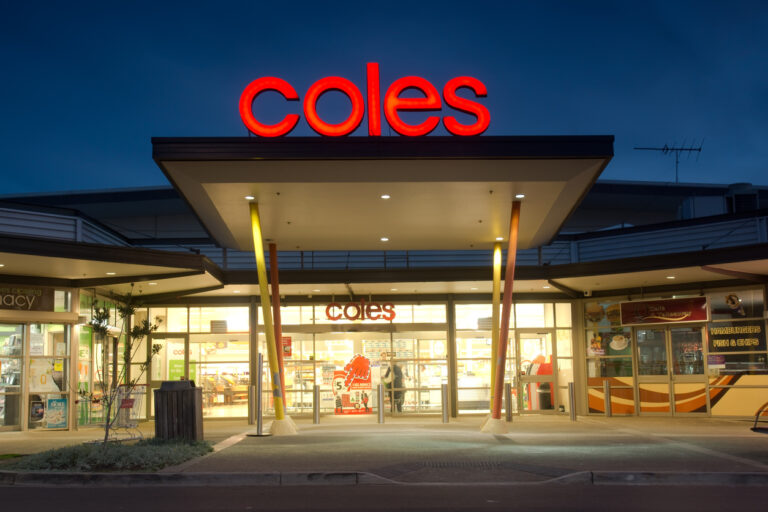
Coles shares (ASX: COL) fell sharply today, dropping 4.8% to close at A$23.12, yet it could have been even worse, with the share price hitting an intraday low of A$22.48 before stabilising somewhat into the close. The move came as markets reassessed the supermarket giant’s valuation on the first day of Australia’s new anti-price-gouging laws, and with rumours of a potential acquisition of pet care business Greencross swirling.
The pullback marks a swift reversal in sentiment after the share price surged to record highs of A$24.59 in yesterday’s session, driven by a defensive rotation into consumer staples amid mounting concerns over Australia’s economic outlook.
The timing of the sell-off is clear. From Tuesday, new federal legislation targets supermarkets with revenues above A$30 billion, banning prices deemed “significantly excessive” relative to cost plus a reasonable margin. Coles and rival Woolworths are the primary targets, and while enforcement mechanisms remain untested, the regulatory overlay appears to have punctured the narrative that powered the stock’s recent breakout: pricing power, margin expansion, and defensive earnings quality in a softening economy.
The move looks like profit-taking after an overextended rally, but it also reflects a deeper tension. Coles has been recast as a macro hedge, with investors piling into staples as growth fears intensified and talk of a potential negative June-quarter GDP print circulated. That defensive bid pushed the stock through technical resistance and into fresh all-time highs, supported by strong supermarket sales momentum and the resolution of a Federal Court case over discount practices. Now, with the regulatory framework tightening and the stock trading at a premium valuation, the risk-reward calculus has shifted.
Top Australian Brokers
- Pepperstone - Top Australian broker - Read our review
- eToro - Invest in ASX and international shares - Read our review
The fundamental backdrop remains solid. Coles reported 4.0% supermarket sales growth in its third-quarter update in early May, with comparable sales up 3.6% and growth excluding tobacco running at 5.7%. Online revenue surged 24.8%, lifting e-commerce penetration to 13.6%, and the company’s own-brand push continues to gain traction, with exclusive-to-Coles sales up 7.3%. Supermarket inflation moderated to just 0.8% excluding tobacco, as Coles absorbed higher meat costs to protect its value perception, a move that helped defuse public anger over grocery prices but also flagged potential margin pressure ahead.
Yet the liquor division is struggling, with revenue down 3.9% and comparable sales falling 4.3%, a reminder that even defensive staples are not immune to consumer caution. The broader political and regulatory environment has also darkened. An ACCC inquiry found that Coles and Woolworths control more than two-thirds of the grocery market and rank among the world’s most profitable supermarket operators, with limited competition. Coles has already been found to have misled consumers under its “Down Down” promotion, and significant penalties are expected. The new price-gouging law, while difficult to enforce and likely more symbolic than punitive in the near term, reinforces the message that margin expansion is now under political scrutiny.
What To Expect
Despite today’s sharp decline, Coles share price remains above its 50-day moving average, which in turn sits above the 200-day average, a classic bullish trend alignment. Volume was elevated at nearly 2 million shares, suggesting repositioning to start the second half of the year, rather than a thin, technical wobble. The setup points to a pullback within an established uptrend, not a structural reversal, but momentum has clearly cooled. The stock’s surge in June, up more than 12% as defensive rotation accelerated, left it vulnerable to any shift in sentiment, whether driven by macro data, rate expectations, or regulatory headlines.
Analysts remain constructive but cautious. The consensus target price sits at A$23.21, implying modest upside of around 2.5% from current levels. That view reflects the quality of Coles’ earnings and its defensive characteristics, but also acknowledges that the recent rerating has run ahead of fundamentals. The Street is not pricing in substantial further gains, and the new regulatory constraints complicate the bull case built around EBIT growth and pricing power. Today’s drop has moved the stock back below consensus, creating valuation breathing room but also highlighting limited conviction in a material re-acceleration.
The bear case is straightforward. The price-gouging law structurally caps margin expansion and adds ongoing friction, even if enforcement proves patchy. Persistent public anger over supermarket pricing raises reputational risk and the threat of volume leakage to competitors, particularly if political scrutiny remains intense. The ACCC’s blocking of Coles’ proposed acquisition in Kalgoorlie underscores constraints on inorganic growth, while liquor weakness and intensifying competition limit group-level earnings upside despite strong supermarket performance. Valuation is no longer a tailwind: after the June rally, Coles is trading at a premium to its own history and catching up to Woolworths, leaving the stock exposed if macro fears ease or yields rise.
The bull case hinges on resilience. Supermarket sales growth remains above market, driven by volume rather than just price, and the company’s digital and own-brand strategies are delivering. Coles has demonstrated an ability to balance value perception with margin discipline, absorbing cost pressures when needed while still posting double-digit EBIT growth in recent results. The defensive thesis is intact: stable cash flows, predictable earnings, and a business model insulated from cyclical swings. If growth concerns deepen or volatility returns, Coles should regain its safe-haven appeal.
Bull Case:
- Supermarket sales growing above market, driven by volume and digital strength
- Defensive earnings profile attractive if GDP concerns deepen or volatility returns
- Technical structure intact with price above key moving averages
Bear Case:
- New price-gouging law caps margin expansion and adds regulatory friction
- Valuation stretched after June rally, leaving limited upside versus consensus target
- Liquor weakness and political scrutiny threaten earnings quality and reputation




