



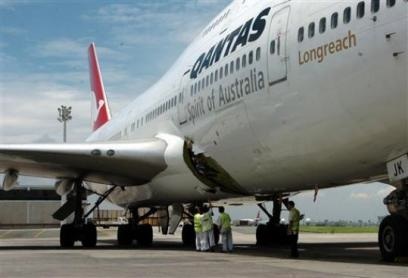
Airline shares across Asia-Pacific markets tumbled on Monday as escalating military conflict in Iran triggered widespread airspace disruptions and sent oil prices soaring, creating a dual headwind for the beleaguered aviation sector. Qantas shares (ASX:QAN) bore the brunt on Aussie markets, although recaptured some of the earlier losses into the close.
The selloff was led by Asia-Pacific carriers facing direct exposure to Middle East route disruptions. Singapore Airlines fell more than 5% as markets absorbed the operational and cost implications of the crisis. Japan’s two major carriers saw equally steep declines, with All Nippon Airways and Japan Airlines each dropping over 5% during Monday trading.
Hong Kong-based Cathay Pacific slipped 3.13%, while Taiwan’s EVA Air declined more than 4%. The pain extended to Australian markets, where Qantas Airways suffered a particularly brutal session, plummeting over 10% to A$8.92, a 10-month low, before recovering slightly to close down 5.43%. Air New Zealand fell 1.06%, and Alliance Aviation Services declined 2.96%.
In a notable divergence from sector peers, Virgin Australia bucked the trend, climbing 4.46% as markets potentially viewed the domestic-focused carrier as insulated from international disruption.
Driving The Move
The airline sector’s sharp reversal comes as U.S.-Israel military operations in Iran intensified following the death of Iranian Supreme Leader Ayatollah Ali Khamenei. President Donald Trump confirmed Sunday that combat operations would continue after three U.S. servicemembers were killed, signalling an extended period of regional instability.
Top Australian Brokers
- Pepperstone - Top Australian broker - Read our review
- eToro - Invest in ASX and international shares - Read our review
Oil futures surged in response to supply chain concerns, with Brent crude jumping 9% to $79.41 per barrel and West Texas Intermediate rising 8.6% to $72.79 per barrel. The increases stem primarily from attacks on vessels transiting the Strait of Hormuz, a critical chokepoint handling approximately 20% of global crude oil shipments.
The operational impact on airlines has been severe and immediate. Airspace closures now span Iran, Israel, Qatar, Syria, Iraq, Kuwait, and Bahrain, forcing carriers to implement wholesale schedule revisions. Major Gulf hubs; including Dubai International Airport, Abu Dhabi’s Zayed International Airport, and Doha’s Hamad International Airport, have suspended operations entirely, stranding hundreds of thousands of travellers worldwide.
Emirates, Qatar Airways, and Etihad Airways have all suspended flights to and from affected regions, contributing to more than 1,800 flight cancellations globally. The disruptions affect not only direct Middle East services but also long-haul routes that typically overfly the region, forcing carriers to implement costly and time-consuming detours.
Impact To Airline Shares
For airlines, the confluence of higher fuel costs and reduced capacity creates a particularly challenging profit equation. Fuel typically represents 20-30% of airline operating costs, meaning the 8-9% jump in oil prices translates directly to margin compression. Simultaneously, cancelled flights and reduced load factors eliminate revenue without proportionally reducing fixed costs.
Qantas, which derives significant revenue from European routes that transit Middle Eastern airspace, faces acute exposure to both dynamics. The carrier’s share price reaction, initially down more than 10%, reflects market concern that the disruption could extend beyond a brief tactical event into a sustained operational challenge.
Japanese carriers ANA and JAL, while less dependent on Middle East transit, face similar fuel cost pressures alongside potential demand softness as corporate and leisure travellers reconsider international bookings amid geopolitical uncertainty.
Outlook
The path forward for airline stocks hinges on two critical variables: the duration of military operations and the trajectory of oil prices. If geopolitical tensions ease and airspace reopens within weeks, carriers with strong balance sheets and diversified route networks may recover quickly. However, a protracted conflict could force airlines to implement capacity reductions, route cancellations, and potentially fuel surcharges, all of which would pressure both revenues and margins.
The airline sector now faces a familiar but unwelcome scenario: external shocks beyond management control that simultaneously increase costs and reduce demand, leaving carriers with limited tactical options beyond waiting for conditions to improve.




